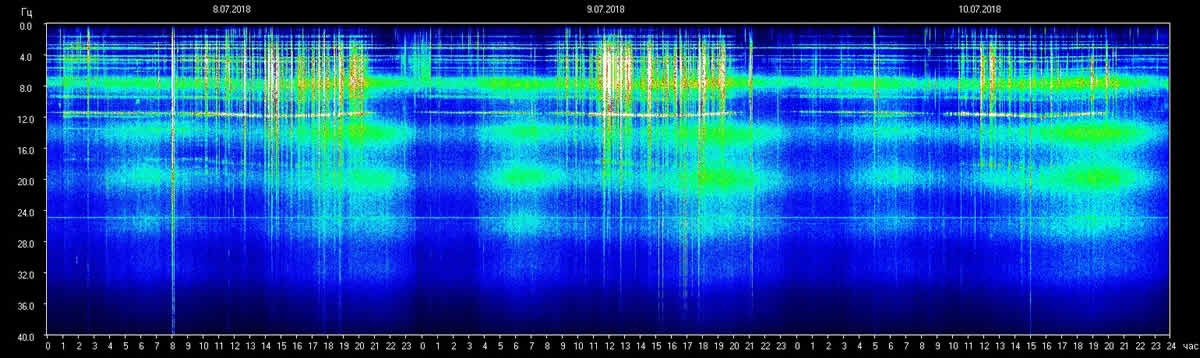
Schumann Resonance Today 7/10/2018 We will try to keep you updated about the variations of the Resonance with this page. The great variations that nobody can explain but that give us a clear sign that the planet is changing. The Earth is vibration higher and higher, just like us! RS Base Frequency 7.83 Hz. Schumann Resonance Today Peaks:
- Nothing significant except a few spike sown on the Italia chart from 15:00 to 17:00 UTC.
- As suggested we arranged the images in an Archive page where all of them are arranged in chronological order for and easier consultation, you can find the link in the banner below.
The Chart time is based on Tomsk – Russia – UTC +7 Source
Note
The Ancient Indian Rishis called 7.83 Hz the frequency of OM. It also happens to be Mother Earth’s natural heartbeat rhythm

Schumann Resonance Today
Explanation of The Chart
Images Archive
All the SR daily images in one single page
What is the Schumann Resonance?
The Herathbeat of Planet Earth
Meteor Live
The below real-time trace is updated every 60 seconds and shows meteors detected over the presceding two minute period.
Time is shown as Universal Coordinated Time (UTC) which is an intenational time standard equivalent to GMT. This avoids regional confusion with local time zones.
“This Hour” is the number of counts since the beginning of the hour. “Prev Hour” is the number of counts in the last full hour. “PHR (15 min)” is the “present hourly rate” based on a 15 minute sample.
Meteor Detection
When a meteor strikes Earth’s atmosphere it decelerates rapidly. The friction created by the air causes the meteor to burn up at extremely high temperatures creating the white “shooting star” that we are all familiar with. This process also ionises the atmosphere along the trail making it possible to reflect radio waves.
Utilising a high powered VHF radar signal sent into the sky, we are able to detect reflected waves from these ionisation trails. Because the meteor is moving very fast, the reflected signal is shifted in frequency, by an amount according to it’s speed. This Doppler shift is also heard as an audible ping by the station operator.
Our system translates the reflected wave into three main parameters – Amplitude (strength), Frequency shift (Doppler shift) and decay time. This allows us to determine the relative size of the meteor strike (vertical scale) and the relative approximate speed and deceleration (width of the trace).
You can see the output from our system above in real time. the graph shows the presceding one minute period. During a meteor shower this trace will be full of meteor strike traces, but it is also surprising how many meteors are striking Earth’s atmosphere all of the time.

Conversion
Life sets aside moments of joy and years of pains. It’s better you convert the moments in hours and the years in minutes.
Costantino Rozzi

