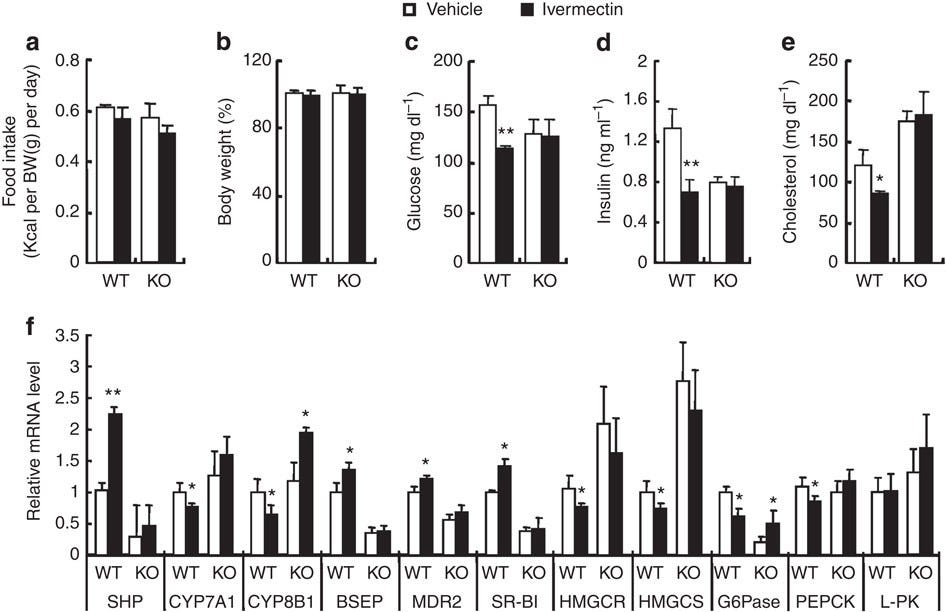
Except that longtime readers of this Substack were well aware of this most expected benefit of Ivermectin lowering blood glucose levels by acting as a direct agonist for the Farnesoid X Receptor (FXR) by suppressing hepatic gluconeogenesis and improving insulin sensitivity, leading to reduced serum glucose and cholesterol levels in diabetic mouse models.
A research study published in Nature titled, the anti-parasitic drug ivermectin is a novel FXR ligand that regulate metabolism
found the following:
WE CONCLUDE THAT IVERMECTIN IS CAPABLE OF REGULATING SERUM GLUCOSE AND CHOLESTEROL LEVELS BY DIRECTLY TARGETING FXR.
Wild-type (WT) and FXR−/− (knock-out (KO)) mice were fed with high-fat diet and i.p. injected with vehicle or ivermectin (1.3 mg kg−1) once a day for 14 days (n=6 per group for all data in this figure). The food intake were measured every second day. (a) Food intake. Kcal, kilocalories; BW, body weight. After 6 h of fasting, mice were weighed and the body weights were indicated as percentage (%) of the initial weight of mice (b). Serum was collected and the levels of serum glucose (c), insulin (d) and cholesterol (e) were determined. (f) Hepatic mRNA levels of metabolism-related genes were quantified by real-time PCR and normalized to actin. Values are the means±s.e.m. of six independent experiments. *P<0.05, **P<0.01 versus vehicle, Student’s t-test.
…TOGETHER, OUR RESULTS SUGGEST THAT IVERMECTIN AS A NOVEL FXR LIGAND MAY POSSESS ADVANTAGES OVER GW4064 IN REGULATING GLUCOSE HOMEOSTASIS.
CIRCADIAN DISRUPTION IS WIDESPREAD IN OUR MODERN 24/7 SOCIETY, LEADING TO AN INCREASED PREVALENCE OF COMMON DISEASES INCLUDING TYPE 2 DIABETES. THE AUTHORS CONDUCTED AN UNBIASED SCREEN FOR SMALL-MOLECULE COMPOUNDS THAT CAN RESTORE THE ATTENUATED INSULIN SECRETION FROM PANCREATIC Β-CELLS CAUSED BY A DISRUPTED CIRCADIAN CLOCK. THEY IDENTIFIED IVERMECTIN AND ITS CLOCK-CONTROLLED TARGET, THE P2Y1 RECEPTOR, WHICH REGULATE GLUCOSE-STIMULATED CA2+ INFLUX AND INSULIN SECRETION IN Β-CELLS. THIS DISCOVERY REPRESENTS AN IMPORTANT ADVANCE IN OUR UNDERSTANDING OF REGULATORY MECHANISMS OF INSULIN SECRETION BY CELL-AUTONOMOUS CLOCKS IN MOUSE AND HUMAN Β-CELLS AND IS OF FUNDAMENTAL CLINICAL IMPORTANCE IN CONTEXT OF NOVEL THERAPEUTIC TARGETS FOR DIABETES MANAGEMENT.
Additional information from a paper titled, Anecdote Meets Evidence; The Ivermectin-Diabetes Hypothesis, maybe downloaded here:
… it turns out Fenbendazole and Ivermectin may also help reverse diabetes.
In a recent X post Dr. Makis asked the following:
THERE HAVE NOW BEEN SEVERAL OF THESE EXPERIENCES
PLEASE SHARE IF YOU’VE EXPERIENCED SOMETHING SIMILAR!
“DON’T KNOW HOW ALL OF THAT WORKS”…HONESTLY I’M WONDERING THE SAME..
It also turns out that Fenbendazole may in fact reverse diabetes; to wit:
Fembendazole and glucose may in fact reverse diabetes
Cancer Cells Love Sugar
CANCER CELLS ARE HIGHLY DEPENDENT ON AEROBIC GLYCOLYSIS — THIS IS KNOWN AS THE WARBURG EFFECT: •EVEN IN THE PRESENCE OF OXYGEN, THEY PREFER TO BURN GLUCOSE FOR ENERGY VIA GLYCOLYSIS. •THIS PRODUCES LACTIC ACID AND FUELS RAPID CELL GROWTH.
TO SUPPORT THIS, CANCER CELLS OFTEN OVEREXPRESS GLUCOSE TRANSPORTERS (ESPECIALLY GLUT1) AND HAVE HEIGHTENED GLUCOSE UPTAKE.
What Fembendazole does to disrupt this?
Inhibits Microtubules •Fenbendazole binds β-tubulin, disrupting microtubule formation. •Microtubules are essential for: •Cell division •Intracellular transport — including moving glucose transporters to the cell membrane. •Result: GLUT1 transporters fail to reach the cell surface → glucose cannot enter the cancer cell efficiently.
Suppresses Glucose Uptake •Without access to glucose, the cancer cell experiences metabolic stress. •Deprived of fuel, it becomes more vulnerable to: •Apoptosis •Cell cycle arrest •AMPK activation
Disrupts Glycolysis Pathways •Fenbendazole also interferes with hexokinase, the first enzyme in glycolysis that phosphorylates glucose. •This further blocks energy production from sugar. •Cancer cells, which are inflexible and addicted to glucose, are hit hard.
WHILE YOU MAY NOT BE DEALING WITH CANCER THIS SHOWS THE MECHANISM OF FENBENDAZOLE AND IT’S ABILITY TO IMPACT GLUCOSE.