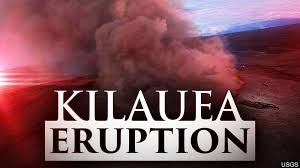
Latest Kilaeau Notes…May 31, 2018


Kīlauea Volcano Lower East Rift Zone Vigorous eruption of lava continues from the lower East Rift Zone (LERZ) fissure system in the area of Leilani Estates and Lanipuna Gardens.

Fissure 8 continues to maintain eruptive fountains reaching 200-250 feet. Subsidiary fountains in the vicinity of Fissure 8 are also active although with much less vigor, seldom exceeding 60 feet in height. This fountaining continues to feed a lava flow that is moving north out of Leilani Estates and then northeast along Highway 132 into the area of Noni Farms road. Flow front advance has slowed to less than 50 yards per hour.

Video of fissure 8 on Kīlauea Volcano’s lower East Rift Zone on May 30, 2018. Fountain heights exceeded 200 feet and secondary fountains reached heights of 60 feet. The second video looks down Kupono Street, just south of Leilani Street, in the Leilani Estates subdivision, where chilled rock from the fissure 8 fountain have fallen. (Public domain.)

By late afternoon, the front of the Fissure 18 flow was about 0.5 miles from Highway 137 and was spreading and slowing. In the late afternoon, a new flow lobe began branching from the south side of the fissure 18 flow approximately 1.5 miles upslope from the flow front. During the day, sporadic bursts of activity were also observed from Fissures 22, 6, and 13.

Low level spattering and intermittent fountaining from Fissure 21 were also observed in the late afternoon and early evening. Pele’s hair and and other lightweight volcanic glass from high fountaining of Fissure 8 are falling to the west of the fissure and accumulating on the ground within Leilani Estates.

Winds may waft lighter particles to greater distances. Residents are urged to minimize exposure to these volcanic particles, which can cause skin and eye irritation similar to volcanic ash. The most recent map of lava flows can be found here: https://volcanoes.usgs.gov/volcanoes/…

HVO field crews are on site tracking the fountains, lava flows, and spattering from multiple fissures as conditions allow and reporting information to Hawaii County Civil Defense. Crews are also checking on the status of ground cracks on Highway 130. Aerial of lava flow Lava flow erupted from fissure 8, photographed during HVO’s early morning overflight today.

The lava channel was estimated to be about 100 feet wide. (Public domain.) Volcanic gas emissions remain very high from the fissure eruptions. Trade wind conditions are bringing vog to the south and west sides of the Island of Hawaii. Magma continues to be supplied to the lower East Rift Zone. Earthquake locations have not moved farther downrift in the past few days and the number of located earthquakes remains low.

Additional ground cracking and outbreaks of lava in the area of the active fissures are possible. Residents downslope of the region of fissures should heed all Hawaii County Civil Defense messages and warnings. Kīlauea Volcano Summit A UAS (Unmanned Aircraft Systems) mission during this past week documented the widening of the Overlook vent.

Earthquakes in the Kīlauea Volcano’s summit region continue as the area subsides and adjusts to the withdrawal of magma. The vent is widening due to the collapse of the steep enclosing walls and rim. Large rockfalls from these areas have triggered explosive events that produce minor amounts of ashfall downwind.

The video surveys the southeast rim of the Overlook vent to the old Overlook parking lot, showing cracks in the rim and areas dusted with ash. Limited UAS flights into this hazardous area are conducted with permission and coordination with Hawai‘i Volcanoes National Park. The information is used to quantify change and informs our assessment of hazards, which is shared with the National Park Service and emergency managers. Footage is courtesy of the U.S. Department of the Interior Office of Aviation Services. USGS/DOI
Hawaii Big Island Lava Field Into Subdivision ~ May 28, 2018


Hawaii Big Island Lava Field Into Subdivision. By Alan D. McNarie.

In 1958, when Hawaii statehood was still a year away, two Colorado businessmen came up with a brilliant money-making scheme: Buy 12,000 acres of undeveloped, dirt-cheap land on the rocky, rainy slopes of the world’s most active volcano, divide it into 4,000 3-acre lots, and sell them for $500 to $1,000 apiece, paid off at $150 down and $8 a month.

Glen Payton and David F. O’Keefe called their subdivision “Hawaiian Acres.” It would forever change the face of the Big Island — not always for the better.

The lots sold spectacularly well,” wrote George Cooper and Gavan Daws in Land and Power in Hawaii. “The effect of this success was electrifying.

A Big Island land boom was on.

Only two years after Hawaiian Acres lots went on sale, a Honolulu Star-Bulletin article could report that at least 11 major subdivisions were underway — including a cluster of 2,231 one-acre lots titled “Leilani Estates,” sited directly on top of Kilauea’s East Rift Zone. The article was headlined, “Here’s Up-to-Date Report on Big Island Subdivisions,” but above the headline were five words in smaller type: “There’s Little Danger from Volcanoes.

In the article, Leilani developer Kenneth W. Ing claimed that “volcanic risk” to his development was essentially less than one in a thousand.

He based his claim on calculations by a University of Hawaii geology professor, Dr. Gordan MacDonald, who had said that since 1750, lava had covered only 20 square miles out of an east Puna area of 125 square miles: “On this basis, the likelihood of lava covering any given plot of land in any single given year is less than .1 percent.

Leilani Estate Hawaii

Leilani Estate Hawaii (civilbeat.org)

Lava Erupts Near The Leilani Estate

Lava Erupts Near The Leilani Estate (civilbeat.org)

Since 1960, lava flows from the flanks of Kilauea have wiped out the town of Kapoho and at least four other communities. But the article also quotes MacDonald as saying, “It is impossible to say how soon volcanic activity might affect any given area, and data are insufficient to assign any significant mathematical probability for such an event.

What MacDonald, Ing and the article failed to mention was that in January and February of 1960, a lava flow had wiped out the entire town of Kapoho, destroying the village’s businesses, a hot springs resort and numerous homes on land adjacent to Ing’s new subdivision. (Correction: An earlier version of the story inaccurately said that nearly 1,000 homes were destroyed.)

Since then, lava has obliterated at least four more nearby communities and subdivisions: Royal Gardens, Kapa’ahu, Kaimu and Kalapana.

Now, it’s the turn of Leilani Estates itself, which so far has lost 36 structures, including at least 26 homes, to the latest East Rift lava event.

As of Sunday more than 2,000 people have been evacuated from Leilani Estates, Lanipuna Gardens and other nearby locations. Underground magma is believed to be moving further down the rift, threatening other communities such as Kapoho, parts of which have been redeveloped since the 1960 eruption into three coastal subdivisions, Kapoho Beach Lots, Kapoho Farm Lots and Kapoho Vacationland.

Those who live in the subdivisions aren’t the only ones who’ve had to leave. County officials have directed the closure of the Lower Puna’s numerous vacation rentals, in order to save water and “reduce the area population so emergency operations can focus on residents.

Affordable Homes — At A Price

Cooper and Daws note that by the time the Big Island land boom wound down in the 1970s, 80,000 new lots had been created on an island that, at that time, held only 80,000 people.

Then-Gov. John Burns spearheaded the drive to transform North Kona and North and South Kohala into what Burns called a “gold coast.” It remains a region of rich resorts and upscale homes. Other developers pumped money into resort hotels along Hilo’s Banyan Drive.

But Puna and Kau became a playground for the wannabe-rich. Those three districts, located on the slopes of Mauna Loa and Mauna Kea, lacked the Gold Coast’s white sand beaches and relentlessly sunny weather. And those pesky eruptions kept making new land — but it was lava and volcanic ash, too hard and raw to be paradise.

Mainland investors and mainland buyers didn’t necessarily know that, however. The developments that grew up there are still sometimes known, locally, as “land scam subdivisions.”

Pam Frierson, in The Burning Island, compares those developments to similar ones that were sprouting up elsewhere in America’s sunbelt, from Florida to the Southwest: “Large scale speculative subdivisions were being carved out of marginal lands — desert, tidal flats, lava lands — and sold as cheap ‘retirement’ or ‘investment’ properties.”

Most of these subdivisions were “substandard,” having a  grid of private roads that didn’t meet county building codes — perhaps paved, perhaps not — and lacking basic services such as running water and sewer lines.

Many eventually joined the island’s power grid, but most still rely on rainwater catchment tanks, and on cesspools or septic tanks to dispose of waste. They also lacked visible means of financial support. Most were located far from jobs. Though usually zoned agricultural, they were carved into parcels too small for conventional farms, even if they actually had tillable soil. Some subdivisions had a general store, but there was no traditional town center, no hub of commerce.

County officials had a huge incentive to go along with the land schemers: a windfall in property taxes from those thousands of new lots. In 1987, Frierson asked then-Hawaii County Planning Director Albert Lono Lyman why the county had acquiesced to all those substandard subdivisions.

“Greed and short-sightedness,” he summarized, noting that “the majority of those lots were sold, sight unseen, to mainland buyers.”

Some subdivisions were the work of mainland investors. California oil company magnate Jack Crawford, for instance, built Ocean View Estates on old lava flows in Kau.

But there were plenty of local players, including state officials. Hawaii County police inspector William Kamau headed the hui that tried to build a failed subdivision called Crescent Acres. State Sen.

Kazahisu Abe headed the Hilo Development Inc., which developed Orchid Isle Estates in Puna. U. S. Sen. Hiram Fong was president of the company responsible for a development called Fern Estates.

Nor was the greed limited to local bigwigs. Cooper and Daws estimated that one in four Big Island families invested in lots.

Big Island money in the lots was dwarfed, though, by outside investments: 12 percent of the lots bought by 1975 were by Big Islanders, 35 percent by Oahu residents, and most of the rest by mainlanders.

With almost no provisions for basic infrastructure, the original investors didn’t appear to actually believe people would live on those lots. But thousands of people proved them wrong.

Hawaii Sen Hiram Fong

Hawaii Sen Hiram Fong

By the time the subdivision boom finally petered out in the 1970s — partly as a result of stronger zoning and planning ordinances, but also, perhaps, because of the sheer glut of undeveloped lots — East Hawaii held at least 15 major substandard subdivisions and several smaller ones — all of them located in Lava Risk Zones 1, 2 or 3, the three highest-risk categories given by the U.S. Geological Survey.

Leilani Estates Residents Evacuate

Leilani Estates Residents Evacuate (civilbeat.org)

One cluster of subdivisions, including Hawaiian Ocean View Estates and Hawaiian Ranchos, clung to the lava field on the steep southern end of Mauna Loa.

But most were in Puna, forming an almost continuous line from Volcano down Highway 11 to Keaau, then from Keaau down Highway 130 to the sea at the eastern end of the island.

Some built in the subdivisions because they’d been suckered in and had to roll with the punches. Frierson interviewed Jack and Patty Thompson, who were among the last holdouts in volcano-ravaged Royal Gardens. They’d invested their life savings in their home, after seeing a promotional movie about a “fertile area directly adjacent to Hawaii Volcanoes National Park.

They didn’t tell you the place sat right below an active rift zone,” Jack Thompson told Frierson.

With the possible exception of Royal Gardens, which was wiped out by a series of lava flows between 1983 and 2012, every one of those subdivisions is inhabited — and many, especially those in lower Puna, are burgeoning, despite the lava risk and the lack of amenities.

They’re the main reason why Puna is the fastest-growing district on the island. According to the Hawaii County General Plan, the district held about 31,300 people in the year 2000.

By 2015, its population had soared to nearly 50,000. By 2020, it’s expected to reach 58,000, surpassing Hilo to become the island’s most populous district. It’s achieved that remarkable growth despite the loss of four communities to molten rock.

USGS Big Island May 26

USGS Big Island May 26

Many more came because land speculation had driven prices sky-high in more desirable locations, and companies building those Kona mega-resorts hadn’t made provisions for housing their workers.

The island ended up with much of its jobs on one side of the island and its affordable housing on the other side, generating another local term: the “5 o’clock derby,” for the early morning commute between Puna or Kau and the North Kona/Kohala resorts.

“Poor people have to live somewhere,” noted one Puna Facebook user.

Many of these later buyers know about the lava, but they have to live with the risk, gambling that Madame Pele won’t come to their homes during their particular lifetimes.

But the odds may be considerably worse than Dr. MacDonald predicted back in 1960. According to the USGS, in the 20 years between 1983 and 2003 alone, another 40 square miles were buried in fresh layers of lava.

Pills Disclosure News Italia

Wise Men

Wise men speak because they have something to say; Fools because they have to say something.

Plato
