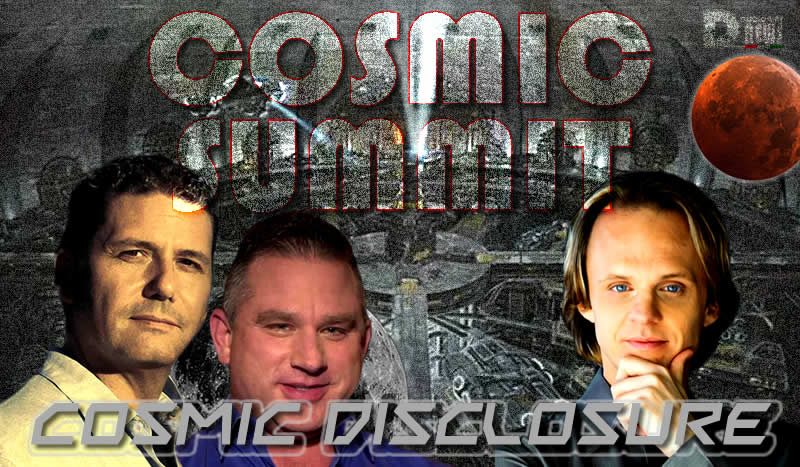
Cosmic Summit. By SBA.
David Wilcock
Welcome to another episode of “Cosmic Disclosure”. I’m your host, David Wilcock. And we have a special treat for you: two high-level insiders who have never before spoken in any public or really private forum in the way that we’re going to right now.
We have Corey Goode and Emery Smith.
Emery, welcome to the show.
Emery Smith
Hey, Dave, thanks for having me again. Very exciting day.
David
And Corey, thanks for being here.
Corey Goode
Thank you.
David
So we decided to start out this first episode by trying to find one of the areas where there might be common ground between the things that you’ve experienced, Emery, and the things that Corey’s experienced. And so this gets into the topic of underground bases.
So just to start this off, I’m going to ask you some simple questions, and then we’ll open it up from there.
Are you aware of either the military or the government, or whatever you want to call it, having underground facilities?
And if so, how extensive are they? How many of them are there? And what do you know about those facilities?

Emery Smith
Emery
I’m aware of, in just the U.S. alone, about 300 of these facilities.
Now, when you say government, I want to, like, talk about that, because it’s not always the government that owns these facilities.
They GUARD these facilities – the military does – but they don’t always… are in control of the facilities, because they are owned by larger corporations and unknown organizations.
Corey
That have different oversight.
Emery
Exactly.
Corey
Right.
Emery
Right.
David
So when you say there’s about 300 of these facilities that you’re aware of…
Emery
Solo in Nord America.
David
…what would be an average benchmark of what you are thinking that that means? What are those facilities? Of the 300, what would they be like?
How big are they? How many people do they hold?
Emery
Right, there’s many different facilities with many different types of populations in them. And they all have a different agenda.
And there are some that are larger, like the ones in New Mexico, Nevada and Colorado, that actually house entire cities, and you never even have to go to the surface.
They also have full running hospitals and whatnot for this elite group.
As far as the laboratories and all the testing going on there with nuclear and other types of energies – because it’s not all just medical, of course…
…but other things going down there, as Corey can also relate to of working on different types of devices, such as different types of vehicles, number one, space vehicles; also, the medical stuff I talked to you about in the last episodes, with all the storing of cloned bodies and whatnot.
So there are a lot of these facilities that house many different types of projects.
And then there are some that are only for specific types of projects, because it’s so compartmentalized, they’ll make a whole underground base just for one project.
And they’ll keep that with the population usually under about 200 people so they can control them.
Corey
So Emery, I know you probably can’t tell us the names of the bases that you went to or where they were located, maybe some, but can you tell us the number and how they were different, as well as what it was like going into the bases?

Corey Goode
Emery
Yeah, sure. Basically, there’s around 300 of these bases in the United States that I’m aware of.
Some of the ones I’ve been to are in El Paso, Texas, under UTEP.
Of course, everyone knows about the one I’ve been in in Los Alamos and Kirtland Air Force Base.
Another one would be in Charlottesville, Virginia. There’s another one in Denver. Of course, Dulce [New Mexico] you know about. And there’s one in White Sands [New Mexico] – under White Sands National Monument.
Also [there’s one] in Creststone [Colorado], underneath the sand dunes, which they’re trying to now expand that.

USA Underground Bases
David
What about in Canada? Are you familiar with any up there?
Emery
In British Columbia and also near Whidbey Island, off of Washington there.

Canada Underground Bases
Corey
When you approach these bases, or these underground facilities, the entrance to them, are they nondescript? Or are they something that…
Emery
eah, 95% of them are nondescript but also guarded or usually near a base or on a base for the entry points.
Now, there are a few that are out there that actually are not guarded, but they’re in such remote desolate areas that . . . I mean, they’re guarded, but they’re not… it’s not…
Corey
With technology.
Emery
It’s not on a base. Right, with technology and satellites.
Corey
They’re monitored.
Emery
And completely monitored, exactly.
So I think most of them, to answer your question, would be: you’d have to enter a really secured lab or a really secured corporation or a really secured military installation to access the underground.
Corey
So could you take us through what would be typical if you were to go through?
Emery
Right, absolutely. Depending on where your entry point is and depending on the type of base it is, some of the most common ones, like the one I was stationed at with Kirtland Air Force Base, was basically a fire tower that you would never even think would be the access point.
And a fire tower, meaning it’s a concrete base, not made out of metal. So I want you to think of a small 30′ x 30′ building, concrete, that goes up about six floors – straight up – but it’s there as a fire observation point, which, of course, never is utilized for that.
And these areas, too, they don’t have, like, parking lots in front of them or anything like that. You usually have to walk through many different posts.
But since this was already on the base, inside another base that’s there . . . so you’re going through two different types of security.
So first you have to get on the military base, number one. And then once you do that, there’s another even more secure base on there with the fences and their own security teams. They’re not military.
And these are private corporations that I spoke of that are running these things.
So one of the things I was speaking to Dave about one time was my dorm was so close to there I would actually ride my bicycle to this place after work. And I was allowed to put my bicycle near the area and then walk over. And this is just an area that people that on base worked there could walk to it.
So there’s many different places to go in, but for us, since it’s more convenient since we live on the base, for many scientists.
David
What would happen if somebody started to notice an unusual number of people going into a fire tower like if you were on the base and it wasn’t your job?
Emery
Well, that whole place is monitored, number one, and you’re already on a base. And the base already knows there’s something… You know, THEY already know there’s something there.
They don’t know the extent of it, though. The military doesn’t always know the extent of how large these underground bases are, which you [Corey] could probably attest to.
Corey
Do they typically bring you through and scan your body? Do all these… I mean, what other types of security measures do they take?
Emery
Sure. So once you get there, like I did, there was actually a bike rack there that I’d put my bike up. And I’d walk right over, and there’s just two doors.
You walk in, and just like you would walk into a hospital to check in somewhere, they take your driver’s license and all that stuff.
So there’s two security guards there, and you walk in.
And they either recognize you, or they don’t recognize you. And you do have three different types of security things you have to do before you go in.
You have a card, number one, and it’s very generic. It’s nothing special. It doesn’t have any…
Corey
Just a strip?
Emery
…holograms or anything in it. Right, it’s just a strip . . . a magnetic strip, like you see on a credit card. So it’s nothing special at all.
Then you have, of course, your palm print identification and your iris eye scan, like the old stuff you see in the movies – very similar to that.
So once you go through that and get through all that, then you take the elevator down.
Once you get to the bottom…
Corey
Where they weigh you while you’re on the elevator going down.
Emery
That’s right. The elevator is not a regular elevator. It looks like a regular elevator, but the elevator is actually scanning you to see if you have any type of, let’s say, plutonium on you or anything that could be a threat.
So this elevator’s doing a body scan on you as you’re going down.
David
Wow!
Emery
Yeah. So you cannot smuggle something in, in your orifices. You could not come in there with a bomb or a grenade or a handgun or anything like that.
David
Is it also like an X-ray, MRI kind of thing, where it would…
Emery
Yes.
David
Okay, I thought so.
Emery
It’s a little different like that. It’s not radioactive causing, where… of course, they wouldn’t do that to you.
David
Right.
Emery
We do wear these special, of course, X-ray badges the whole time we’re in there, because it monitors how much radiation you have.
Corey
You’re exposed to.
Emery
Right. And it’s not always just from the X-rays. It could be other projects in there that are using stuff that it is emanating at a safe level. But they have to monitor you the whole time.
Corey
Do they keep a running tally of any exposure you had to radiation…
Emery
Absolutely.
Corey
…accumulation?
Emery
Everyone’s monitored for gas and radiation and specific light wavelengths, actually, that could cause damage to the body.
So those are the three things they are monitoring all the time.
David
Okay, so, Corey, since you’ve also had experience with underground bases, at this point, is there anything funny that jumps out at you – anything that he said that was familiar or unfamiliar?
Corey
Oh, yeah, absolutely familiar. And like he said, there’s different types of bases.
Some of the bases are . . . you cannot access them from the ground whatsoever. You have to go through the tram system, the secret tram system underground.
Emery
Yeah.
Corey
And the only entrance and exit is through that tram system.
David
Right.
Corey
And often, they will be very deep, as I’ve said before. At a certain depth, you’re no longer considered in United States territory.
David
Um.
Corey
And so you then have free rein.
Emery
Absolutely, yeah.
David
Have you seen…
Emery
And I was getting to that, because once you get down there, you have to take the tram.
And many of them have different types of maglev and lavatube devices to get you there.
Corey
I don’t think we’ve had someone that could give a good description of the tram. I know they have short ones for people that you sit in and you’re facing each other.
Emery
Right.
Corey
And then they have the larger ones. Can you give a description?
Emery
Yeah, sure. I spoke about this in the past. And one of the ones is kind of like a, as Dave and I call it, like a gondola.
So when you get down there, there’s a chair you sit in, and it goes down a very, very long hallway.
And it just keeps going around and around and around. It’s very slow, as fast as… a little bit faster than you’d see at the airport when you stand on those… the standing conveyor belts.
Corey
Right.
Emery
So just a little bit faster than that. And you’re sitting down, or you can stand up. You don’t have to sit down.
And that takes you to the actual main entrance of the underground base, and it could be as long as a quarter mile.
Now, they also have the actual tube system, which is a pod, and it holds up to four people.

Conveyor Belts
And it’s in the shape of a cylinder egg.
And you get in that one, and it has really nice chairs in it, actually, kind of like the reclining ones you would see on a dentist table, but really padded.

Tube System

Tube System Pod

Tube System Pod Detail
Cosmic Summit
And you can actually wear a seat belt in these things, but you don’t need to. You don’t even know you’re going because it’s so fluid, and it gets up to such a high speed.
And I don’t know how fast that is, but I heard some of these can go over 500 miles per hour.
Corey
Yeah, I was hearing over 700.
Emery
Yeah. So once you get there, whether you’re taking the chair, the gondola, or you’re taking these maglev tubes – the egg thing – once you get there, then you have to still go through another security checkpoint.
Corey
Because you could be in another country for all you know.
Emery
Right. Or another planet.
Corey
Right. Exactly. I was actually talking about that recently, about how . . . Recently, when I was brought up to the Lunar Operation Command, I was brought into a room for a briefing, and there was a window.
And I looked out the window, and I saw Mars.
Emery
Ha, ha. Yes.
Corey
And I was told that a lot of times, people will take these trams. And much like I took a tram, and it ended up on another planet…
Emery
Yes.
Corey
…back when I was much younger, and you can’t really tell.
Emery
It’s not like a… You don’t go into some hyperjump, or you’re even aware of it. It’s that fluid when you do these kinds of portal jumps, I’ll say. It’s in seconds.
Corey
And they play games with the people when you get there. You’ll see windows that make it look like you’re on Earth somewhere or on Mars.
Emery
Right. Yeah, we talked about this. Absolutely.
Corey
And they were doing that on the Moon when I was in there, and they said, “Ah!”, and they flipped it over to a moonscape when they saw me staring at Mars kind of confused.
David
Let me also just say for the record that Bob Dean, Pete Peterson, Jacob and Henry Deacon have all reported on this phenomenon of sub-shuttle systems where you get transported somewhere else, and you don’t even realize it.
You’re just riding in the thing, and you go somewhere else.
So this is a consistent element of insider testimony that I’ve heard.
Corey
Yeah, they could take a scientist, put him in one of the underground trams. They could end up at another facility, and it could be on the Moon.
David
Right.
Corey
And they could… And the facilities on the Moon… it looks just like Earth facilities.
David
Right.
Corey
And then walk them around. Let them see out the window – see the Grand Canyon or something – and the people totally believe that they’re at a location on Earth.
Emery
It also helps with the psyche, if you’re living underground for a very long time, to have these views and…
Corey
Yeah, trees and plants.
Emery
…to have the organic state material, with gardens inside these things.
Corey
Full spectrum lighting.
Emery
Full-spectrum lighting, and the things that we normally have here outside they try to replicate inside. And it seems to lower the stress levels of the scientists and the technicians that are working there.
David
Yeah, let’s go with that, because one of the things that Pete Peterson reported to me was this idea that you might have a very large dome underground in which there is a city, with buildings and roads and trees.
Emery
Right.
David
And it really… And they even have the dome lit so it looks like the sky.
Emery
Yeah, the dome is really cool.
Corey
And they do starlight. They do stars at night.
Emery
They do. And you have your own 24-hour, like you said – the day and night situations. They can make it look like a hurricane’s coming, too, with clouds and all sorts of amazing sci-fi effects that are very realistic, as far as the lighting goes, and the way it makes you feel like you’re looking into infinity.
Corey
I’m curious. Were any of these bases that you went to… were they in national parks?
Emery
Yes. Yeah.
Corey
Interesting. We’ve heard tale, and you and I have seen doors that will just open up out of the side of a mountain.
Emery
Right.
Corey
And they can completely… you could never tell that there is anything there. You could go there with a . . . do sonic tests. You would never know that there’s a door there.
Emery
You can’t even find it with a metal detector.
Corey
Right.
Emery
And this is like a giant rock, like you just said, will open up. And it’s completely sealed and pressurized, out of the side of a mountain.
And we were talking about this earlier, Corey. Even in the desert… Like, I always remember watching the desert open up, like you said, which you can explain.
Corey
Right. Like a zipper.
Emery
Like a zipper.
Corey
The ground.
Emery
And then the sand starts falling in. And I’m always like, man, who’s cleaning up all that sand?
Corey
Right.
Emery
But they have a special thing that…
Corey
Yeah, it drains sort of those…
Emery
Just collects it right out and shoots it back out over the . . . once the door shuts, shoots it back on top of that.
Another type of base that I don’t get into too much, you know, up in the North Pole in the polar ice caps – there’s bases in polar ice caps…
Corey
Mh-hm.
Emery
And they are magnificently beautiful, number one. And they somehow have their own atmosphere in there…
Corey
Yeah.
Emery
…with perfect running water and their own, I’ll say, their own electricity they make using the Earth, because they’re already very, very deep.
Corey
Is that like geothermal?
Emery
Yes.
Corey
Right.
Emery
Yep.
Corey
Are these… And some of them also use the thorium-type reactors.
Emery
THORIUM – absolutely.
Corey
Yeah, so…
David
I’ve heard a lot about thorium.
Emery
That’s a big one. Thorium’s amazing, yeah.
David
It’s basically a non-radioactive fusion system.
Emery
Right.
Corey
Well, what’s interesting is that in a lot of my presentations I’ve been showing footage from Project Iceworm.
And basically, the same type of building was done down in Antarctica as well. And planes would come and land and provide them the supplies.
But this is also how they’ve built a lot of off-world bases…

Project Iceworm
Emery
Right.
Corey
…this same method. But Project Iceworm was very interesting because later on, the United States tried to smuggle some nuclear weapons there, and the plane crashed.
And everyone found out about this huge base that was secretly built.
David
Just so you guys are aware of this, one of the things that Pete Peterson told me was that the “World Book Encyclopedia” in 1953, I think was the year, that the military-industrial complex sent people all over libraries to rip out this one page because it had something in there talking about how thorium could be a reaction that would produce almost no radiation.
And he said that if we started to use this, that we would have this incredible breakthrough in technology.
So what do you guys know about thorium as it relates to our discussion?

Project Iceworm Base Structure
Corey
Well, I know that in the programs, the craft, research vessel, I was assigned to, originally it was nuclear. And then they replaced it with thorium based [power].
And then they replaced it with some sort of an electromagnetic engine that had these long tubes that they would put something in that they called “minnow baskets” that would spin.
And if you move it up and down, you get a little bit of play in the electromagnetics.

Thorium
Emery
Right.
Corey
And I think it’s some sort of electromagnetic friction that’s going around. And these leads are picking up the energy and shooting it wirelessly through the tubes, which then go directly to these huge capacitors.
Emery
Right. Yeah, a lot of capacitors are used in these bases to hold the energy.
I’m not an expert at thorium, but I was recently on a project where a private organization – a private corporation – hired me to . . . They sent out people all over the United States – a scientific team – to find the LARGEST deposit of thorium here in the United States.
And I know exactly where that’s at. And that is also in New Mexico. I’m not going to tell you the city it’s located near, but I’ll tell you it’s in New Mexico.
And there’s an unlimited amount of thorium there that could power all the planets, and all the bases, and, of course, us right here indefinitely – INDEFINITELY – I mean with the amount of energy we already currently use.
David
So why do you think, Emery, there would be a base in a national park? What would be the advantage to that?
Emery
Oh, the advantage of that is, number one, it’s completely monitored all the time. You always have park rangers around.
So it’s like you have your own little civilian operatives out there.
And, of course, they’re just cluttered with satellites and stuff that are watching them – watching the area, I mean.
So these areas also sometimes have a great usage to them because they’re near maybe an underground thermal or something.
Corey
Right.
Emery
And they’re harvesting this energy. Or maybe it has a huge crystalline formation under some of these parks and stuff.
So the parks, even in early days, were actually picked out to hide military bases.
Corey
Yeah, what’s interesting is Clifford Mahooty, when we had him here talking, said that reservations – Indian reservations – and these bases and national parks have the same classification with the government.
Emery
Yes. And that’s what I’m saying, because it’s limited traffic, or it’s controlled traffic.
Even on the reservations, like… You’re not even allowed to go on a reservation, you understand, unless you have special passes and whatnot with the chiefs.
And what happens is that’s the perfect ideal place that’s never going to have a lot of traffic or a lot of investigation, because we’re using an area that we already gave to the American Indians.
Corey
GRight. It was interesting. I read a report that a lot of the groups of park rangers were actually intelligence.
They were former military and intelligence, because in a lot of these national parks where people “go missing”, they end up finding the missing people.
And sometimes they had been worked on by non-terrestrials, and they needed to keep it quiet…
Emery
Sure.
Corey
…so they had the park rangers smooth everything over.
Emery
Yeah, I can attest and agree to that 100%, that they’re using a show of force, or let’s just say a security detail, that is not what you would think of someone just graduating college and taking up a job.
These people are 20-year-plus veterans either in the projects or in the military, as you said. And they’re very overqualified, but they get paid really well.
David
So one thing I’d like to follow up on, Emery, is you mentioned bases under the ice.
Emery
Yeah.
David
And I would assume this also would include bases in the ocean.
Emery
Yes.
David
There’s this very strange movie that came out 2009 called “G.I. Joe”, which is military, but all the stuff that we’re talking about is in that movie all over the place.
What do you feel about the movie “G.I. Joe”? And did you have any…

G.I. Joe Rise of Cobra
Emery
I do recall seeing that. I don’t remember it too well, but I do recall seeing it and connecting the dots, we’ll say.
And I think there was a lot to it at the time. I remember watching it and saying, “Wow! Here they are just coming blatantly out.”
David
Because it’s so…
Emery
…and showing…
David
They’re doing these beautiful visuals in the movie with computer animation.
Corey
Oh, yeah, well, especially the second one when they did the Rods from God attacks…
David
Oh, that was crazy.
Corey
…on the Earth when that’s exactly what we’re looking at in the North Korea thing.

G.I. Joe Retaliation
Emery
Right. Right. Interesting. I didn’t see the second one.
David
They’re telephone-pole-sized pieces of tungsten that you can drop onto the Earth, and just gravity causes a very, very severe explosion that can devastate a huge amount of space.
Emery
Oh, yes. Yeah.
David
And he had talked about that. And I only watched the second “G.I. Joe” film recently, and I couldn’t believe that it was in there.
Emery
Wow! Yeah, that’s pretty amazing for them to blatantly come out and expose that classified information, but we do start to see that now all the time with the movies are giving tidbits.
There’s the Alliance and other white hats that get to throw a couple of messages in there for those who are paying attention…
David
Right.
Emery
…and talk about it. So I think it’s a great thing.
David
So another thing I’d want to bring up now is: when I spoke to Bob Dean, retired Major Bob Dean, he actually told me a lot more than he ever said publicly with Project Camelot or anyone else about what he really had been involved in.
It’s very similar to what Corey’s done.
And one of the things he talked about was an island in the South Pacific that looks like an island if you fly over it, but if you get really close, half of the island is some kind of hologram, and it’s camouflaged.
And you can go through that hologram, and then you find out there’s a whole base there…
Emery
Yeah.
David
…that you can’t see from the sky. Are you familiar with anything like that?
Emery
There’s lots of that.
Corey
Yeah, lots of that technology – the masking technology with holograms.
Emery
Lots of it.
Corey
They’ve even developed holograms to a point to where they have mass.
Emery
Right.
Corey
Or they call them “hard light”, to where they can…
Emery
You can cast a shadow.
Corey
Yeah, you can do a hologram, and you can walk up and “tink, tink, tink,” like a piece of glass.
Or even they can make it even thicker in depth.
David
Wow!
Emery
Yeah, I totally can attest to that as well, and I was part of . . . not part of that, but there were compartmentalized projects near me during that that were working on satellites that could do that, or they were putting that technology in satellites in the early ’90s, and I think it was probably before that.
Corey
Yeah. What’s crazy is they’ll have a hard light panel. They remove the source of the power or electricity, and it stays.
Emery
Right.
Corey
I mean, it’s incredible.
Emery
Yeah, they’re using all sorts of cool technology. That’s why I always say, you know, if I did see something, a craft or whatnot, an ET, it’s hard for me to say, “Oh, that’s real. or it’s not real”, unless I actually was right in front of it and analyzing it, because they can make you really believe you saw a plane crash into a building.
Corey
Mm-hm.
Emery
They can make you really believe that’s really something there. And you can get up to it, like Corey said, and it’s palpable.
David
Really?
Emery
It is actually palpable. And the ones I’ve seen were not as palpable as yours were. You’re like… Mine was just for a little bit, and then you could just easily go through it.
Corey
Right.
Emery
But that’s just an amazing technology to begin with, because then you can basically make any type of threat – fake threat – or use it for horrible situations where you’re trying to…
Corey
They’re using it for building.
Emery
Yeah.
David
Would they create areas where, like, NOAA [National Oceanic and Atmospheric Administration] would have a no-fly zone? So, like, you couldn’t fly a passenger plane or an airliner over these areas?
Emery
Oh, that’s right now. Right now they have it everywhere. There are certain places you can’t… no-fly zones.
And that’s a great way to also investigate when you’re trying to find places.
David
Ah, ah.
Emery
And you’re like, “Well, why is it way over here? This is a no-fly zone.”
David
But, like, if you have a little Cessna, what would happen if you tried to go towards one of these zones, let’s say.
Emery
You immediately would be escorted out by some F-16s…
Corey
Yes.
Emery
….or F-15s or whatnot.
David
Okay, it seems pretty strange that they could have this hard-light technology or a hologram cloaking something.
Somebody at some point is going to find it. Somebody’s going to be sailing in a little skiff…
Emery
They have.
David
…on the ocean or something. So what would happen in those situations?
Emery
They have, and they were terminated.
David
Really?
Emery
Missing at sea. Or even in military operations, sometimes THEY accidentally stumble.
Corey
Training operation.
Emery
Right, and they’re not supposed to be there, but they are. And they are usually terminated.
Corey
“Dead in a training operation” or something.
Emery
Yeah, they were, like you just said, . . . People that work at these bases, too, their families don’t know that they’re going to a base to work for three months.
They’re just saying, “I can’t contact you for three months because I’m going on a mission.”
So when they do die, and they tell the family, “Oh, they died in action or on a training mission”, it’s completely false. It’s completely fake.
And they’ll never know, because the best people to hire are military people that are active duty, because they’re very expendable.
David
What other methods do they have to protect the base from people showing up so that they don’t actually have to kill people? What are some of the other methods?
Because I would hope they don’t always do fatalities.
Corey
You know, they’ll do things like put out signs stating that there’s radiation, that this was a testing zone for nuclear weapons and try to deter you that way.
Emery
Well, they have many things in place to deter you from going there, but sometimes it just happens.
You know, you can’t have a sign every 50 feet and when you’re 100 nautical miles out with this island and stuff.
But there are boats that are always . . . and aircraft that are always patrolling those areas.
And the satellites that are assigned to these bases, they’re always there. And a fleet can’t even get in there without them knowing that there’s something in the airspace.
David
Wow!
Emery
You could not fly under radar to these places. You WILL be caught. You WILL be found.
David
Do you think there are certain cases where people would be brought into the base and become employees or maybe unwillingly become employees instead of just being shot?
Emery
I’m not aware of that.
Corey
I am, unfortunately.
Emery
Yeah?
Corey
Yeah. There have been, for the biometric testing and stuff, they’ll take people.
Emery
Oh, for testing. Right.
Corey
Yeah.
Emery
Yeah, I’ve seen them get kidnapped.
David
Hm.
Emery
And people were there against their will, but not to be working for someone. I’ve never seen that. But, absolutely, what Corey just said is unfortunately true.
Corey
Did you ever hear of any security measures to protect against “psychic spying” or remote viewing?
Emery
Absolutely. All the bases have dedicated remote viewers on board.
And don’t forget, remote viewers don’t have to be on the base.
Corey
Right.
Emery
They could be far away and still protecting the bases.
And you get two good remote viewers – and that’s one of my specialties that I actually get paid for… is you have a remote viewer, let’s say, that’s 90% effective.
And then you get another remote viewer that’s, like, 90% effective. And they both come up with the exact same thing.
So you only need a few of those guys on board to check out surveillance.
Now, they do have people that are advanced remote viewers that are using…
Corey
Remote influencers.
Emery
Right. Say it again.
Corey
Remote influencers.
Emery
Right, remote influencers that also use consciousness-assisted technology and electronics that they hook up to.
Corey
Have you seen some of the…
Emery
Yes.
Corey
There’s either a pole or a plate that they put their palms on.
Emery
Two gold plates or…
Corey
Well, one is copper, and one looks like it’s a stainless looking steel. And it’s hooked up to wires. And they’ll sit there, and it enhances their ability.
The remote viewers that try to view military bases, they’ll begin to see a view of the base, and then all of a sudden, their thoughts are scattered.
And what they were being called in the smart-glass pads, which is an awkward way to label them, but they called them, “Those that Scatter”, because they were scattering the thoughts of anyone coming in.
And they were also sending energetic feedback through the connection and giving people what they called “ethereal headaches”, which for days you have a huge headache. And I’m sure you know what that’s…
Emery
Oh, yes.
Corey
…what those are.
David
All right. Well, that’s very amazing stuff, and that’s all the time we have in this episode with Emery Smith, Corey Goode and myself. We’ll see you next time. Thanks for watching.

Can’t Be Done
Everybody knows that something can’t be done, and then somebody turns up, and he doesn’t know it can’t be done, and he does it.
A. Einstein

