———————————————————

Illustration by The Epoch Times
Editors note: I Am definitely a mosquito magnet living in eastern rural North Carolina, which is known for high temps and humidity during the summer. Thus… LOTS of mosquitos here!
May I offer another reason for being a “mosquito – magnet”? Perhaps people carrying more spiritual light within themselves, even if unknown, may also turn mosquitoes on. I think light-filled blood cells are way more attractive to vampire mosquitoes, don’t you?
To learn more about why you may be attractive to mosquitoes, please read on below..
———————————————————
If mosquitoes always seem to find you first, it’s not bad luck—it’s chemistry. Scientists have spent the past decade figuring out exactly what makes some people mosquito bait and others practically invisible, and the answer has nothing to do with sweet blood.
While popular urban legends such as having “sweet blood” remain weakly supported, recent studies are shedding light on the specific signals that mosquitoes use to choose their targets, and on what, if anything, you can do about it.
How Mosquitoes Find Humans
“They’re little vampires,” Jeff Riffell, a biologist and professor at the University of Washington, told The Epoch Times.
Like vampires, mosquitoes don’t pick their victims at random.
Their hunting strategy begins with sniffing you out from a single breath. An exhale acts as a lighthouse, Riffell said.
“Scent is this long-distance attractant,” he said. “The carbon dioxide is this long-distance cue that tells them, ‘Oh, there’s someone around.’ They’ll smell it from 100 meters away or so.”
Identifying the presence of a nearby warm-blooded mammal is just the first stage. To choose a specific person, mosquitoes rely on a multi-sensory approach. A 2014 study
published in Cell found that mosquitoes respond to a combination of cues, including carbon dioxide, body odor, and body heat, that work together to guide host-seeking behavior. Researchers genetically engineered mosquitoes that could not detect carbon dioxide and found that although their attraction to humans was reduced, it was not eliminated.
As mosquitoes close the distance, they bring in additional senses.
“Then they’ll use a variety of other cues to kind of hone in,” Riffell said. “They’re not only using their sense of smell, they’re also using their vision to find you. And then they’re also using sensitivity to heat.”
At close range, skin odor becomes the dominant factor, shaped by a mix of chemicals released by the skin that ultimately seals your fate. It is undetectable to humans, but our skin gives off a distinct, pungent odor to mosquitoes, signaling that it’s dinner time.
“What’s really driving the attraction is the skin odor,” Riffell said. “They start smelling you based on your skin.”
This is the stage at which the mosquito magnet of the group you’re in becomes clear.
“If you are not sure you’re a mosquito magnet, then you are not a mosquito magnet,” Riffell said.
What Makes Some People Mosquito Magnets?
Specific skin-derived chemicals appear to be a major reason why mosquitoes prefer certain people. A 2022 Specific skin-derived chemicals appear to be a major reason why mosquitoes prefer certain people. A 2022 study and a 2023 study published in Current Biology found that some people are consistently more attractive to mosquitoes than others, and it linked this heightened attraction to higher levels of carboxylic acids on the skin.
Carbolic acids are molecules produced when skin bacteria break down compounds in sweat and skin oils.
“It’s clear that individuals that are very attractive to mosquitoes are emitting higher levels of these carboxylic acids, but it’s not clear which ones are mediating the response,” Riffell said.
Two people may both be mosquito magnets and emit high levels of carboxylic acids, he said, but the specific chemicals within that class of carboxylic acids can differ between them.
The research also found that these differences remain stable over time.
“Your smell is remarkably consistent over time,” he said.
Carboxylic acids are only part of a much larger scent picture. A 2020 review published in Frontiers in Microbiology found that mosquitoes are strongly guided by odor signals produced by skin microbes, which convert skin compounds into chemicals that vary from person to person.
“Our skin hosts a diverse community of bacteria and fungi in our skin microbiome,” Katie Costanzo, associate dean and the director of the environmental science program at Canisius University, told The Epoch Times in an email. “These microorganisms metabolize compounds produced by our skin and generate secondary compounds that are released into the air and detected by mosquitoes.”
The invisible ecosystem on our skin is shaped over time by environment, lifestyle, and biology.
“In many ways, our microbiome reflects the places we have lived and the experiences we have had,” Costanzo said.
Ultimately, mosquito attraction results from multiple overlapping biological signals rather than a single cue. For some people, several of those factors may work together to create the perfect storm.
“Some individuals naturally produce more heat, exhale more carbon dioxide, or emit higher levels of certain volatile compounds, making them more attractive,” Costanzo said.
Other Factors That May Influence Mosquito Attraction
Scent and skin chemistry drive most of the attraction, but a few other factors can tip the odds further.
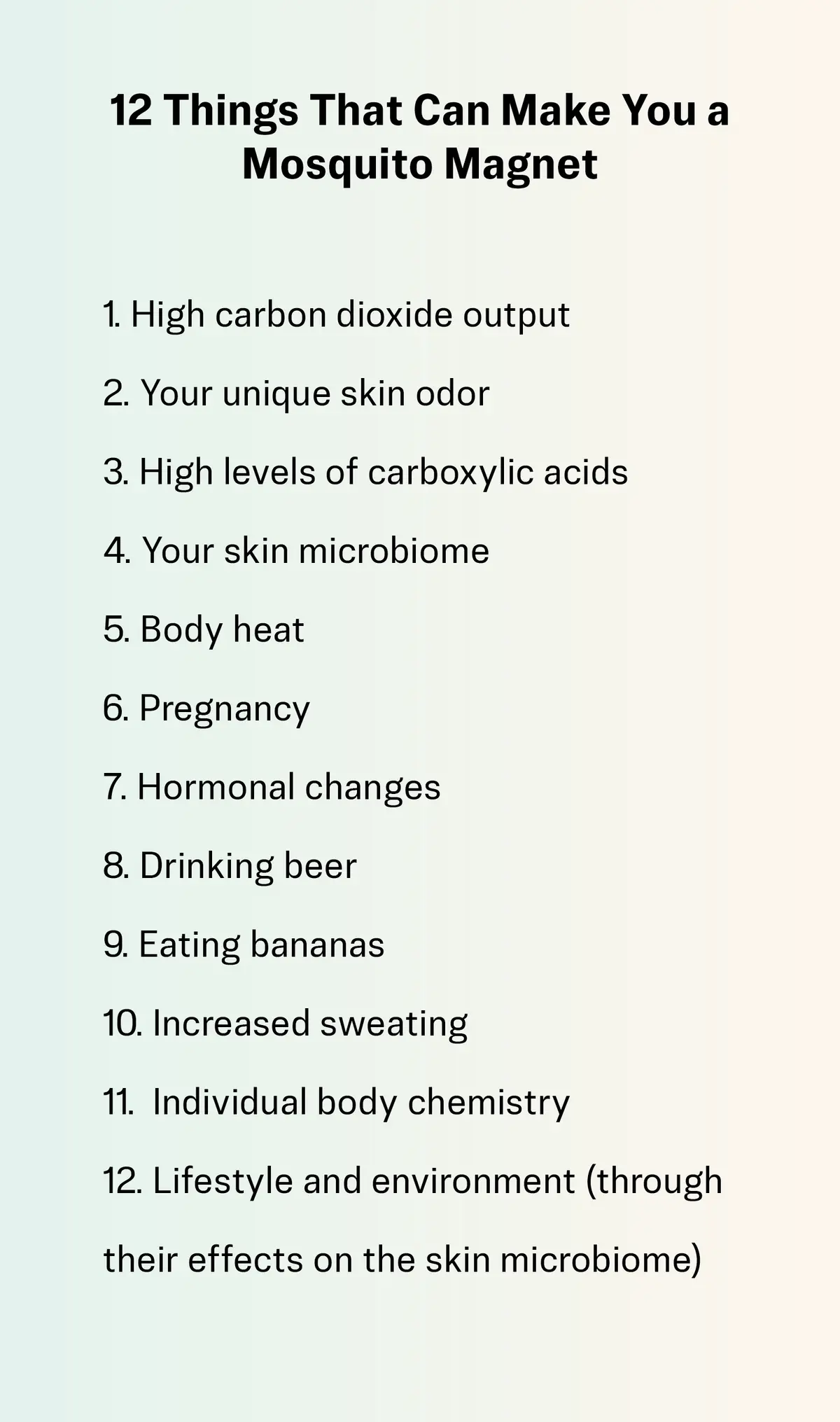
“The foods and beverages we consume can alter our body chemistry and potentially affect the compounds we emit through our skin and breath,” Costanzo said.
There is some evidence that suggests mosquitoes may gravitate toward the beer drinker at the barbecue. A 2010 study published in PLOS One found that beer consumption increased mosquito attraction and flight toward human odor, even though carbon dioxide levels and body temperature did not change.
“When you’re drinking alcohol, it’s increasing the blood flow,” Riffell said. “You might be sweating more.”
What’s known about alcohol’s effect remains specific to beer; whether wine or liquor produce similar effects remains largely unstudied.
Some evidence points to eating specific foods, such as bananas. A 2018 study published in Insects found that eating bananas increased human attractiveness to malaria mosquitoes in controlled experiments, while grapes had no effect. The effect was consistent across mosquito species and repeated trials,
Eating bananas may increase attraction, likely due to metabolic byproducts released by the body,” Costanzo said.
Pregnancy is a well-established factor that attracts mosquitoes. Research
shows that pregnant women are twice as attractive to them as non-pregnant women.
“Hormones play a major role in regulating sweat glands, oil production, and the balance of bacteria that naturally live on the skin,” Dr. Annette Czernik, board-certified dermatologist, told The Epoch Times in an email.
Can You Make Yourself Less Attractive to Mosquitoes?
Mosquito magnets can’t change their natural scent.
“You can’t alter your natural body chemistry completely,” Czernik said.
However, there are steps you can take to make yourself harder to detect.
- DEET: “ I know a lot of people don’t really like DEET, but it is the best and arguably the safest way to prevent mosquito bites,” Riffell said. “It’s been tested for the last 70 years, and it’s the most effective thing. You become essentially invisible to the mosquito. It’s also considered safe during pregnancy.”
- Permethrin-Treated Clothing: Mosquitoes are very sensitive to permethrin and will die on contact.
- Cover up: Cover any exposed skin with clothing or repellent, especially around feet and ankles, which tend to carry a stronger scent.
- Citronella and Eucalyptus Oil: These natural alternatives work, but they wear off faster than DEET.
- Light-Colored Clothing: Mosquitoes favor dark colors.
- A Fan: “Mosquitoes do not like airflow,” Riffell said. “They’re relatively poor flyers.”
- Swatting: “If someone’s trying to swat them, they will then go to the next person who’s not swatting them,” Riffell said. “They’re capable of learning. They can be quite plastic in their responses; they’re flexible.”
- Fragrance-Free Skincare Products: Strong soaps and perfumes can shift your scent profile in either direction.
- Avoiding Standing Water: Buckets, gutters, flowerpot saucers can harbor mosquitoes—empty them, or use larvicide “mosquito dunks” where you can’t.
The science may eventually catch up with mosquito magnets: Some researchers are looking into skin creams that could alter the skin microbiome and change the odors mosquitoes use to find us. Others are experimenting with knocking out genes involved in mosquito smell, potentially creating mosquitoes that are unable to detect humans at all.
Until then, however, your best bet is flying under their radar as much as possible.
Correction: A previous version of this article misspelled the name of Canisius University associate dean Katie Costanzo. The Epoch Times regrets the error.- —————————————————

