_____________________________________________________________________________________________
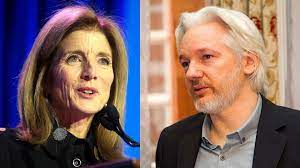
US Ambassador to Australia Caroline Kennedy indicated in comments to the Sydney Morning Herald that Washington might be open to a plea deal for WikiLeaks founder Julian Assange that could keep him from being extradited and imprisoned in the United States for exposing US war crimes.
When asked if the US and Australia could reach a diplomatic solution on Assange, Kennedy, the daughter of President John F. Kennedy, told the paper that it was an “ongoing case” being handled by the US Justice Department. “So it’s not really a diplomatic issue, but I think that there absolutely could be a resolution,” she said.
The comments come as the Australian government of Prime Minister Anthony Albanese has pressed the Biden administration on Assange. Secretary of State Antony Blinken rejected Australia’s concerns when he recently visited the country, claiming that Assange “was charged with very serious criminal conduct in the United States in connection with his alleged role in one of the largest compromises of classified information in the history of our country.”
Kennedy pointed to Blinken’s comments but again hinted that a deal could be made. “But there is a way to resolve it,” she said. “You can read the [newspapers] just like I can.” When asked if the US could reach a deal to reduce charges against Assange, she said, “That’s up to the Justice Department.”
Gabriel Shipton, Assange’s brother, said Kennedy’s comments were a sign that the US was thinking about resolving the issue. “Caroline Kennedy wouldn’t be saying these things if they didn’t want a way out. The Americans want this off their plate,” he said.
Assange faces up to 175 years in prison if extradited to the US and convicted under the Espionage Act for publishing documents he received using standard journalistic practices. The Herald suggested a “David Hicks-style” plea bargain could be on the table, referring to an Australian who was held in the notorious US torture camp at Guantanamo Bay in the early 2000s.
Hicks was accused by the US of providing “material assistance to terrorists.” According to Consortium News, due to pressure from the Australian government, Hicks was released after agreeing to an Alford Plea, a type of plea in which the defendant pleads guilty but maintains that they’re innocent. Under such an arrangement with Assange, the US could downgrade the charges and take into account the four years he’s been locked up in London’s Belmarsh Prison, and Assange would serve his remaining sentence in Australia.
Don Rothwell, an international law expert with the Australian National University, told the Herald that Assange would likely have to travel to the US for such a plea. But Assange’s family and legal team believe he must avoid the US at all costs due to the harsh condition of American prisons and fears that he might take his own life. “Julian cannot go to the US under any circumstances,” Shipton said.
Bruce Afran, a US constitutional attorney, told Consortium News that there’s nothing technically prohibiting a plea being taken without Assange being in the country. “In a given instance, a plea could be taken internationally. I don’t think there’s anything wrong with that. It’s not barred by any laws. If all parties consent to it, then the court has jurisdiction,” Afran said in May on CN Live!, Consortium News’ webcast.
Afran said a potential plea deal could involve Assange pleading guilty to “mishandling official information or even, in the worst case scenario, conspiracy to mishandle official information, a far lesser charge.” Such an arrangement could still set a dangerous precedent for press freedom as Consortium News noted it would criminalize the relationship between a journalist and a source.

