_____________________________________________________________________________________________-
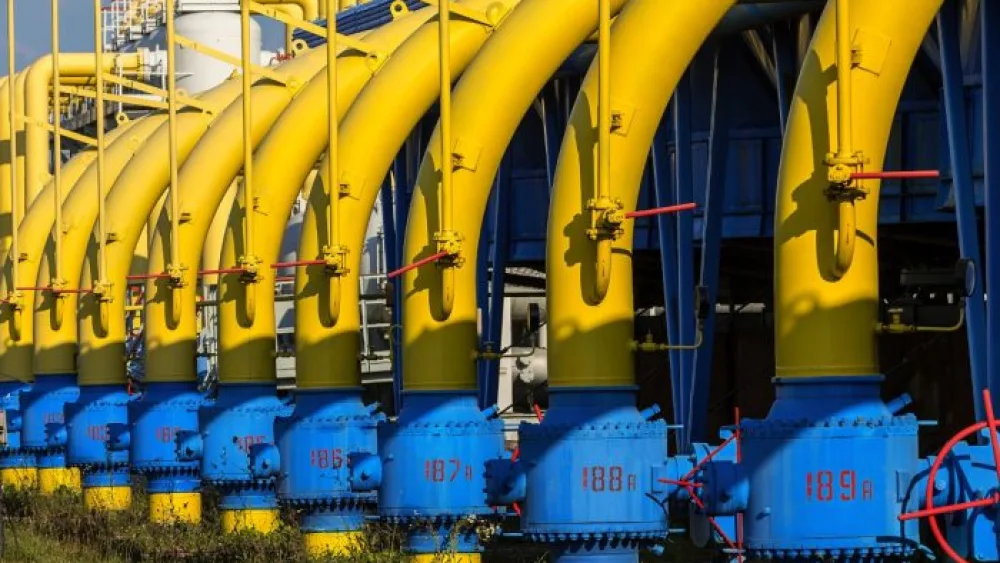
KYIV, Ukraine — With its blasted Nord Stream pipelines draped uselessly across the bottom of the Baltic Sea, Russia is left with only two ways to get its natural gas exports to Europe. There’s the TurkStream pipeline under the Black Sea to Turkey — and then there’s Ukraine.
After more than seven months of full-scale warfare, about 42 million cubic meters of Russian gas still flows through Ukrainian pipelines to Europe each day, sustaining an economic artery for Moscow’s sanction-riddled wartime economy while also providing Kyiv a source of revenue worth about $7 billion over five years. Yet, just one day after explosions breached the Nord Stream 1 and 2 pipelines on Sept. 26, the Russian state gas company, Gazprom, threatened to stop sending gas through Ukraine over a contract dispute.
According to a 2019 agreement, Ukrainian pipelines were to transit 65 billion cubic meters of Russian gas to Europe in 2020, and then 40 billion cubic meters of gas each year thereafter until 2024. To meet 2022’s annual goal, Ukraine needed to transit roughly 110 million cubic meters of Russian gas each day. Despite the full-scale invasion on Feb. 24, Ukraine remained on track to meet that number as late as April 5. That day, more than 109 million cubic meters of Russian gas flowed through Ukrainian pipelines to Europe, including 76.74 million cubic meters through Ukraine’s Sudzha pipeline entry point, and 32.35 million cubic meters through the Sokhranivka entry point.

It wasn’t until May that combat forced Ukraine’s gas transmission system operator, GTSOU, to shut down the Sokhranivka transit route. In an effort to uphold its contractual agreement, GTSOU offered to reroute Sokhranivka’s gas volume through the Sudzha route. Gazprom refused. By Sept. 26, the daily volume of Russian gas through Ukraine was down to 42.7 million cubic meters — about 40% of what’s needed to meet the annual goal.
According to GTSOU data, the Sudzha route has a daily capacity of 244 million cubic meters of gas transmission, more than double the daily requirement to satisfy the 2019 Russo-Ukrainian transit contract — enough, even, to replace the disabled Nord Stream 1 pipeline, if Moscow chose to do so. Yet, Gazprom is using Sudzha at 17% capacity.
In other words, even with Nord Stream totally out of commission, Ukrainian pipelines can still deliver every drop of Russian gas needed by Gazprom’s European clients.
“Despite the Russian invasion and ongoing military activities, the Gas [Transmission System Operator] of Ukraine continues to fulfill all its obligations to clients and ensure stable gas transit to EU countries,” the GTSOU reported in August. “Gazprom, on the other hand, is reducing supplies through all available transit routes without explanation, even resorting to burning gas but not transporting it to the EU. There are no technical reasons to limit gas supplies to the EU. Nevertheless, Russia is reducing its export volumes.”
Gazprom has also refused to pay its gas transit bill to Ukraine, claiming Naftogaz, Ukraine’s state-owned energy company, failed to meet its transit volume quota this year. For its part, Naftogaz argued that Gazprom refused to reroute gas through the Sudzha pipelines. Moreover, the 2019 contract was a “take or pay” agreement, obligating Gazprom to pay a fixed price no matter how much gas it actually sent through Ukraine’s pipelines.

To recover its revenue, Naftogaz filed an arbitration case against Gazprom on Sept. 9 with the Paris-based International Court of Arbitration. According to a Naftogaz press release at the time: “Funds were not paid by Gazprom, neither on time nor in full.”
Gazprom responded on Sept. 27, calling Naftogaz’s arbitration case “an unfriendly step.” The Russian gas giant also threatened to sanction Naftogaz — a move that would halt all Russian gas transit through Ukraine.
On Sept. 28, Naftogaz CEO Yuriy Vitrenko condemned “Gazprom’s disregard for the rule of law and its association with the Russian Federation’s war of aggression against Ukraine.”
“The fact is that Naftogaz has invoked Force Majeure in respect of transit through entry point Sokhanovka because it is controlled by Russian armed forces, and instead offered transit through entry point Sudzha at no additional cost,” Vitrenko wrote on Twitter.
He added: “Naftogaz has therefore provided the required services, but Gazprom has refused to make use of the services.”
Last-Ditch Effort
More than seven months into Russia’s full-scale invasion, Ukraine has gained the battlefield momentum and is incrementally retaking its territory. On Saturday, Oct. 1, Ukrainian units took control of the city of Lyman in Ukraine’s Donetsk oblast, one of four Ukrainian regions Russian President Vladimir Putin claimed to have annexed the day prior. This week, Ukrainian forces are also advancing in the southern Kherson oblast, another region Putin claimed for Russia in his Sept. 30 speech at the Kremlin.
With its invasion in shambles, Moscow’s window to turn things around is narrowing. Russia’s shambolic national mobilization roundup is unlikely to change the war’s course, and Ukraine continues to enjoy sustained military aid deliveries from its Western partners. Weapons such as American HIMARS rocket systems have made a big difference on the battlefield.

Against that backdrop, undercutting Ukraine’s lifeline of Western military aid is among the Kremlin’s top wartime priorities. To that end, Moscow is withholding energy exports to Europe, intending to inflict enough economic pain that Western leaders withdraw their sanctions against Russia and rethink their support for Ukraine. Putin said as much during his Sept. 30 speech.
“You can’t feed people with paper dollars and euros,” Putin said. “You can’t warm people with puffed-up valuations — you need energy sources.”
Last year, the EU imported around 155 billion cubic meters of Russian gas, making up roughly 45% of the bloc’s total natural gas imports. On Sept. 7, Gazprom reported that its natural gas deliveries to the EU dropped by 48% so far this year. With winter fast approaching, this cutback has sent European gas prices soaring and sparked fears of an imminent economic recession.
In 2021, about one-third of the EU’s Russian gas arrived through the Nord Stream 1 pipeline, which runs about 745 miles under the Baltic Sea from Russia to Germany. After Nord Stream, Ukraine is the second-largest route for Russian gas to the EU, accounting for about 24% of total transit volume last year — roughly 37 billion cubic meters of gas in all. For its part, the TurkStream pipeline can deliver about 31.5 billion cubic meters of Russian gas each year to Europe via southern pipeline connections.
Opened in 2011, Nord Stream 1 can normally deliver 55 billion cubic meters of gas per year. Nord Stream 2, which runs parallel to the existing Nord Stream 1 pipeline, would have doubled that capacity, but the $11 billion pipeline never went operational after construction ended in 2021. On Feb. 22, Russia’s military buildup around Ukraine spurred German Chancellor Olaf Scholz to cancel his country’s certification of Nord Stream 2.

Until this year, Russia also had at its disposal the Yamal pipeline, which crosses Belarus to Poland and Germany and has an annual gas flow capacity of 33 billion cubic meters. In March, however, Putin declared that “unfriendly” countries — Poland included — would have to pay for Russian gas in rubles. When Poland balked at the demand in April, Gazprom stopped sending gas through the Yamal pipeline.
“Russia’s aggression against Ukraine has confirmed the accuracy of the Polish government’s determination to become completely independent from Russian gas,” Polish Climate Minister Anna Moskwa said in May.
he Yamal shutdown was the opening salvo of Russia’s energy war. Claiming maintenance issues, Gazprom reduced Nord Stream 1’s gas flow by 60% on June 15. After a brief shutdown in July, Gazprom reopened Nord Stream’s spigots, but only at 40% capacity.
During this supposed maintenance on Nord Stream 1, Russia could have, at any time, rerouted the pipeline’s gas transit shortfall through Ukraine. Nevertheless, Gazprom continued to use Ukraine’s pipelines at only a fraction of their capacity.
“It has been a long-term Russian goal to control all supply routes to Europe,” Sergiy Makogon, CEO of Ukraine’s GTSOU, wrote in an Aug. 5 release. “It is Russia’s efforts to weaponize energy, not lack of transit capacities, which is preventing Europe from getting more gas right now. The aggressor country continues to pressure European governments, using false pretexts, for the failure to meet its obligations.”
BREAKING:
The Swedish Coastguard has found a 4th leak from the Nord Stream pipelines.
It comes from Nord Stream 2, is located in Sweden’s Economic Zone and measures 200 meter in diameter. pic.twitter.com/B7HSXEgo1v— Visegrád 24 (@visegrad24) September 29, 2022
On Aug. 31, Gazprom closed Nord Stream 1 indefinitely. After originally blaming a gas leak, Kremlin officials changed their tune on Sept. 5, demanding Western sanctions relief in order to resume gas flow through the undersea pipeline. Weeks later, unaccounted-for blasts created devastating leaks in both Nord Stream pipelines. Many defense experts say Russia was likely responsible. For his part, Putin blamed “Anglo-Saxons” for the sabotage.
“It is clear to everyone who benefits from this,” Putin said on Sept. 30, overlooking the fact that Russia had already stopped sending gas through the undersea pipeline in a bid to extort Western sanctions relief.
“When discussing the problems of gas supply via Nord Stream 1, Europe should not forget that there is an alternative option — the Ukrainian [gas transmission system],” said Makogon, the СEO of GTSOU.
Despite war-related sanctions, the EU remains Russia’s largest overall energy importer by a wide margin. From the beginning of Russia’s full-scale war in February until the end of August, more than half — about 54% — of the roughly $158 billion in Russian revenue from fossil fuel exports came from sales to the EU, according to the Center for Research on Energy and Clean Air, or CREA, a Finnish research group.
Buoyed by soaring fossil fuel prices, overall energy exports produced about $43 billion in revenue for the Russian government during the full-scale war’s first six months, CREA reported.
Ukrainian Air Assault Forces are entering Lyman, Donetsk region. #UAarmy has and will always have the decisive vote in today’s and any future “referendums”. pic.twitter.com/gGIIk9rNkG— Defense of Ukraine (@DefenceU) October 1, 2022

