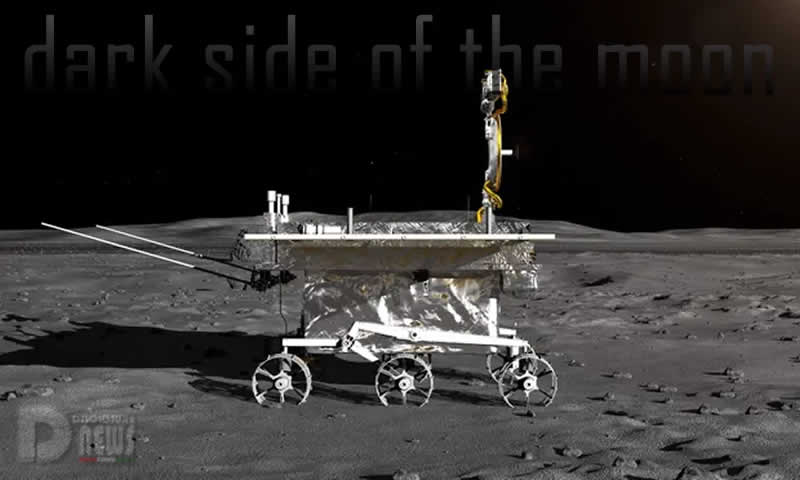
Chinese Rover on the Moon – Dark Side. By Zero.
The Chinese robotic spacecraft, Chang’e 4, will land on Thursday 3 December on the “dark side” of the Moon, in a milestone for human space exploration. The Chinese National Space Administration (CNSA) aims to land the spacecraft in the unexplored South Pole, in the Aitken Crater, the largest, oldest, deepest crater on the lunar surface.

View of Aitken from Apollo 11 to 121 km altitude. Diameter 135 km.
Chinese Rover on the Moon – Dark Side
The launch, on the Long March 3B, was from Xichang, China, on December 7, 2018. The Chang’e 4 probe entered an elliptical path around the Moon last weekend at an altitude of 15 km from the surface.
Regardless of the rover mission, we would be mainly curious to know the reaction of the Chinese when they are received by the locals.
Diameter 135 km. View of Aitken from Apollo 11 to 121 km altitude.
Aitken is a large impact lunar crater on the far side of the Moon, named after Robert Grant Aitken, an American astronomer specialized in binary star systems. It is located south-east of the Heaviside crater and north of the unusual Van de Graaff formation. Aitken was a target observation on Apollo 17 because of the orbit of the command module that passed directly over it.

Rendering of Chang’e 4 Rover on the Moon

Lunar South Pole, the Aitken Crater

Impossible
You need to demand the impossible, so the impossible will happen.
Eraclito

