In 1965, a classified research program inside the Defense Advanced Research Projects Agency (DARPA) confirmed something that would destroy the entire pharmaceutical industry overnight:
Human tissue — including nerve cells, organ tissue, and spinal cord fibers — can fully regenerate when exposed to a precise electromagnetic frequency window between 7.83 Hz and 14.1 Hz.
The project was code-named OPERATION LAZARUS.
⟁
They tested it on 214 soldiers with catastrophic battlefield injuries. Burns. Severed tendons. Shattered vertebrae.
The results were classified TOP SECRET — UMBRA:
— 94% of subjects showed complete tissue regeneration within 36-48 hours — Bone fractures healed in 4 days instead of 6 weeks — Nerve damage previously considered permanent reversed entirely — Two paraplegic soldiers regained full mobility within 11 days
The lead scientist, Dr. Robert O. Becker, later published fragments of this research in his book “The Body Electric” — and was immediately stripped of all federal funding, blacklisted from every university, and erased from medical history.
⟁
Here is what they classified:
Your DNA is not a fixed code. It is a receiver.
Every strand of your DNA operates as a fractal antenna — it receives and transmits electromagnetic information. When your body is exposed to the correct frequency, your DNA activates repair sequences that mainstream medicine says are “impossible.”
This is not theory. This is documented Pentagon research.
Your body was designed to heal itself. They turned off the signal.
⟁
Why was this buried?
Because a cured patient is a lost customer.
The global pharmaceutical industry generates $1.48 trillion per year. Every dollar depends on one lie: that the human body cannot heal itself without chemical intervention.
OPERATION LAZARUS proved this was false — in 1965.
For 61 years, soldiers have had access to regeneration technology in classified military medical facilities while civilians are told to “manage their symptoms” with pills that create new diseases.
⟁
The MedBed is not a concept. It is not a theory. It is not “coming soon.”
It is a 61-year-old military technology that has been used on thousands of soldiers in underground medical facilities — and deliberately withheld from the civilian population to protect a $1.48 trillion industry.
The frequency is real. The regeneration is real. The suppression is documented.
They told you healing takes years. The Pentagon proved it takes hours. Now you know why they classified it.
Editor note: Of course, we are in the “perfect storm“ right now (no other way). Personally, I expect food on the shelves will start disappearing, but not quite so soon.
What better way to clear out processed foods with all those yucky chemicals in them? After shelves are cleared of groceries, the US military will supply better quality nutritional foods for our needs.
When will this happen? We have no way of of knowing, however, in my local market, I have seen supplies shrink a bit along with higher prices, of course.
Stay tuned, the best is yet to BE! 😄💕🌹
———————————————————
You’re probably already feeling it. Higher gas prices. More expensive groceries. That quiet unease when you walk down the aisles and notice gaps where staples used to be. A sense that things are getting shaky, not just economically, but systemically. But what’s coming in the next few months might be much bigger than just another price hike.
This isn’t doom-scrolling. This is a warning based on cold, hard data.
Many energy experts, government reports, and major financial analysts agree: a perfect storm is hitting our fuel supply right now. The world is about to run short of oil, not because it’s all gone, but because a critical chokepoint—the Strait of Hormuz—was effectively severed for nearly three months. Yes, a “peace deal” was recently announced to reopen it, and the headlines are breathing a sigh of relief. But don’t let the spin fool you. The damage is already done. Three months of restricted flow have gutted reserves, scrambled supply chains, and left refineries playing catch-up, a situation that could take years to resolve. The pipeline isn’t fixed just because the ink is dry.
Here’s the connection most people miss: fuel moves food. Without diesel, tractors don’t harvest. Without fuel for shipping, cargo vessels don’t dock. Without trucking, fresh produce doesn’t reach your local store. And even with the Strait reopened, the ripple effects of that prolonged closure are still working their way through the system—first in fuel, then in food, then on your dinner table. Within days of a sustained disruption, you’re not looking at higher prices—you’re looking at empty shelves. First the perishables, then the canned goods, then the basics. It’s not alarmist; it’s logistics.
But here’s the good news: you are not powerless. While the system lurches, you can step off the roller coaster. One of the simplest, most underrated ways to protect your family is sitting right in your pantry: sprouts. No soil, no sun, no green thumb required. Just seeds, water, and a few days. In that short window, you get fresh, enzyme-rich, nutrient-dense food that no supply chain can touch. While others scramble, you harvest.
This is what true preparedness looks like. Not panic, but action. Not dependence, but resilience. The storm may be coming, but you don’t have to be caught in it unarmed. Start small. Start now. And keep your table full, no matter what the shelves look like tomorrow.
”Tank Bottoms” (What It Means)
You’ll be hearing this phrase soon: “tank bottoms.”
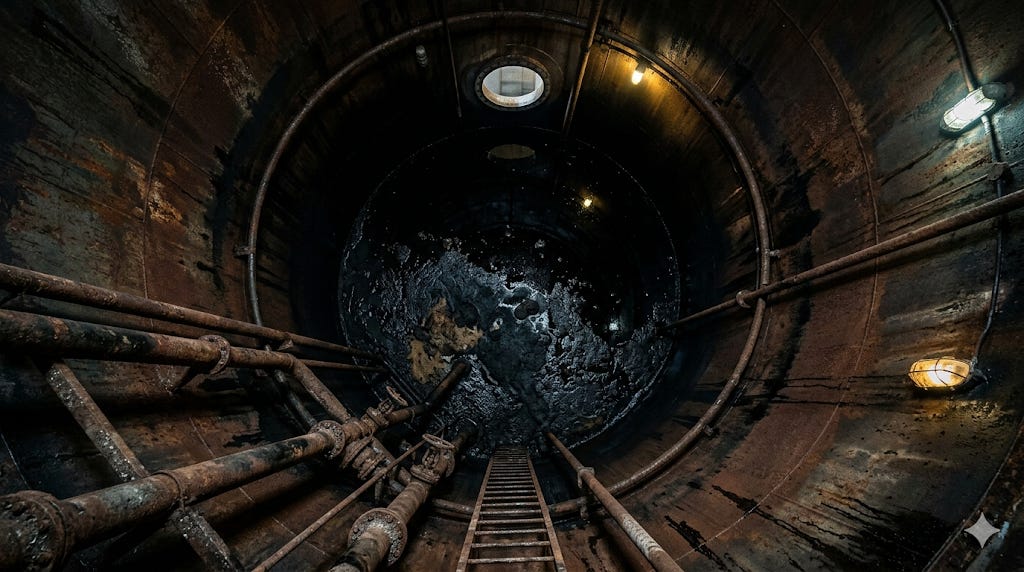
It doesn’t mean tanks are simply low. It means they’ve dropped so low that the pumps can’t pull out the remaining oil. Sediment and gunk at the bottom of the tanks clog the system. Think of it like running your car on fumes, except the needle isn’t just on empty; the tank is so dry that even the dregs are unusable.
Industry executives have been flagging this to the Trump administration in recent weeks, and their warnings are stark. “We’re at dangerously low levels already,“ one executive told officials, according to E&E News. “
We have shared those concerns at the highest levels of government about what’s coming in mid-to-late June. … I hope they are paying attention to inventories right now. You’re hitting tank bottom.”
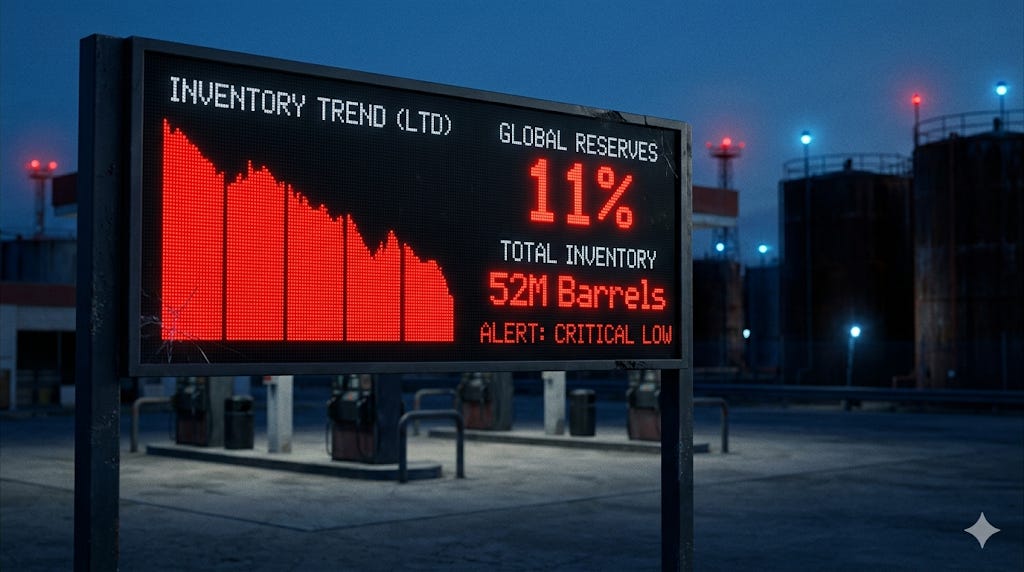
The numbers back up the alarm. Total U.S. commercial petroleum inventories—crude oil and finished fuel combined—are down 52 million barrels since the war began. Globally, stocks have fallen by roughly 5.8 million barrels a day, a decline of about 500 million barrels overall. As S&P Global’s Jim Burkhard put it: “I’ve never seen inventory numbers fall so much so quickly. It is stunning.”
The recent 3-month closure of the Straight of Hormuz burned through the world’s safety net. And reopening the door doesn’t instantly refill the pantry. As one oil executive warned, “Don’t think that an open strait is going to mean your July 4 gasoline bill isn’t going to be higher than what it is today. It’s going to be.”
Even Exxon’s senior vice president, Neil Chapman,
dated Brent crude could hit $150 or $160 a barrel soon. “You can debate whether that’s going to hit those really low levels in two weeks or three weeks. Once you get to that point, then you’ll see prices shoot up.”
So when the USA hits “tank bottoms,” the fuel system doesn’t just slow down; it stops working. It doesn’t matter how much money you have; the fuel is physically gone. Not expensive. Not scarce. Gone. And reopening a shipping lane doesn’t magically refill those underground storage tanks overnight. The pipeline is flowing again, but the reservoir is empty.
This isn’t a theory. It’s basic physics. And the consequences will be felt far beyond the gas station—right down to the food on your table.
The Numbers Don’t Lie
U.S. diesel and jet fuel inventories are 11% below the five-year average—the lowest since 2005, according to E&E News
Globally, we’re using up oil reserves at a rate of 5.8 million barrels per day—a decline of roughly 500 million barrels overall since the war began.
Total U.S. commercial petroleum inventories, crude oil and finished fuel combined, are down 52 million barrels since the conflict started, according to EIA data
When diesel becomes scarce, trucks stop rolling. When trucks stop, food doesn’t get picked up from farms, processed, or delivered to stores. If the shelves are empty, it may not be because of panic buying. They’ll empty because there is literally no fuel to move the food from where it grows to where you live.
This isn’t a price crisis. This is a supply crisis. And it might lead to a food crisis.
No Quick Fix
Even with the Strait of Hormuz reopened, a full return to pre-war production levels will take months, not days. According to Reuters, analysts at Wood Mackenzie estimate that fields affected by the closure could get back to 70% of prior production within three months and 90% within six months, with the final 1 million barrels per day taking “considerably longer.” Refining is an even bigger bottleneck. The war shut as much as 3.52 million barrels per day of refining capacity, about 3.5% of the global total, according to industry monitor IIR. While plants that were simply shut as a precaution could restart in a couple of weeks, repairing damaged sites will take much longer. Gulf refineries might reach 90-95% of capacity within 40 to 60 days, per Vitol Bahrain’s head of research, but the total repair bill for the Middle East is estimated at $46 billion, with refining and petrochemical assets accounting for the largest share due to their complexity. And then there’s the inventory problem. Global oil stocks have shrunk by more than 1 billion barrels since the conflict began, according to Ninety One’s head of natural resources. As he told Reuters, Oil markets will therefore likely suffer a ‘hangover’ for several years as governments seek to rebuild inventories and insulate themselves from further geopolitical shocks.” The world’s usual safety net, OPEC, can’t help because its biggest producers were stuck behind the very chokepoint that was closed for three months. Meanwhile, the U.S. is exporting record amounts of fuel to help allies who are even more desperate, draining our own supplies faster in the process. It’s a lose-lose.
the shortages are “baked in”—inevitable, no matter what happens with the war or the recent peace deal to reopen the Strait of Hormuz. The damage is done. The buffer is gone. And no amount of diplomatic optimism can refill a tank that’s already run dry.
How to Prepare—and Find Hope 🌱
This isn’t about fear; it’s about action. The situation is serious, but you have more power than you think. The goal isn’t to panic; it’s to make smart, practical moves right now, starting with your pantry, your community, and your own two hands. Begin with the basics. Stock a two-week to one-month supply of non-perishable, long-shelf-life foods like rice, beans, canned goods, dried pasta, and oatmeal. Store clean water in containers and have a backup plan, such as a water filter or a local natural water source. If you can safely store a small amount of extra fuel for emergencies, do it now.
Then shift your focus to local. Know your farmers and markets; the communities that fare best will be those with local food production, not those dependent on food shipped 1,500 miles away. Connect with your neighbors. Share information, tools, and skills. A community that works together survives better than individuals alone. Now here’s the hopeful part, and it’s more powerful than you might realize. 😊You don’t need a farm to grow fresh, nutrient-dense food. You don’t even need a backyard. All you need is a jar on your kitchen counter.
Enter sprouting: seeds that have just started to grow, packed with far more vitamins, minerals, and enzymes than the mature plant. Broccoli sprouts for example, contain sulforaphane, a compound with remarkable cancer-fighting and detoxifying properties, and studies show they have up to 100 times more of it than mature broccoli. They’re easy to digest, fast-growing, and cheap: a few tablespoons of seeds cost very little and will provide a week’s worth of fresh greens.
Growing them is almost absurdly simple. All you need is a wide-mouthed glass jar, a piece of cheesecloth or a sprouting lid, and organic seeds—broccoli, alfalfa, radish, or mung bean are great to start. Soak 1-2 tablespoons of seeds in filtered water for 8-12 hours, then drain and rinse thoroughly. Prop the jar upside down at an angle to ensure all water runs out; this is the most important step to prevent mold. Rinse and drain 2-3 times a day thoroughly, keeping the jar in a well-ventilated spot out of direct sunlight. In 5-7 days, your jar will be full of fresh sprouts. Rinse them one last time, let them dry, and store them in the fridge. Add them to salads, sandwiches, soups, or eat them as a snack.
This is a small act of defiance and hope. While the world’s supply chains get shaky, you can create your own fresh food. It’s a daily reminder that you are not powerless. You can nourish yourself and your family with a simple, ancient, and life-giving skill. The situation is serious. Our leaders failed to plan for this.
But here’s what you can do: prepare, connect with your community, and start growing. Don’t spend your energy on fear. Spend it on action. Start with a jar of seeds, and take the first step toward self-reliance. What you do in the next few days and weeks matters. Start with your pantry. Start with your neighbors.
And for goodness’ sake, start a jar of sprouts today. 🌱
Editors note: Many thanks to blogger E for this share!🌹
———————————————————
“Dear Patriot – you have been through more than you let on, more than anyone knows: the sleepless nights; the relatives, friends and strangers who laughed at you – the moments you questioned yourself. The times you had nothing left, but still chose to believe. You held on when others folded. You stayed when it would have been easier to walk away. That makes you rare, dangerous and destined.
“You may not feel it right now – but this is the final stretch before everything changes.
“There will come a day when you’ll sit in stillness and remember the version of you who refused to give up – the one who showed up broke, exhausted and ridiculed – but you never let go of the vision. That day is coming. And when it does you will cry – but not because you’re hurting – because it finally all made sense: All the pain, doubt, delays and all the missed exits.
It wasn’t punishment. It was preparation.
“You weren’t meant to get rich fast. You were meant to become someone unshakeable. You are awake, alive and know this matters. Now you’re too far in to turn around and way too close to fold.
“The storm is loud, but your intuition is louder, and it’s been screaming at you from the beginning: “Hold on. Just Hold.”
“This moment is once in a lifetime. You won’t see it again. Not like this. Not at this price. Not with this setup.
“So breathe. Trust your gut. Silence the noise and when this ends – when it finally ends – you’ll be the one they come to asking how you knew. And you’ll smile – because deep down, way down, you always knew.
“I’m proud of you. You’re almost there. Finish the mission. I love you.” …Anon
———————————————————
Notes to Readers:
On my X feed, at least, the rumors of the coming EBS are getting louder. Prepare yourselves. No dates. Never dates, but some significant disclosures are about to be released, including the truth about 9/11, the 2020 election, J6, and so much more. Meanwhile the QFS system is primed and ready to replace the petrodollar central banking system as the new financial system (and so much more); the Starlink satellites are in place which will be the new connection instead of the old internet, and a lot more. The educational system is going to change. The banking system will change; banks will be phased out, replaced by digital accounts and credit unions (for loans, etc.). All the old control factors will be exposed and removed. A ton of changes… so I hope y’all have been doing your own research to prepare your minds and hearts. The normies are going to be shocked out of their socks…
Will it be this week, next week, next month? Don’t know. That’s above my pay grade…
Breathe, folks, breathe… And thanks for being here.
Eliza Ayres, Sunny’s Journal
———————————————————
Share this: Send the word out using these buttons!
Immigration progressI Trump seeks ‘long shot’ 2nd try on birthright at SCOTUS; 5th Circuit rules cheap tuition for illegals is, well, illegal; historic H1-B criminal cases; and new deep state firings.
Good morning, C&C, it’s Friday! Your roundup includes: the Trump Administration gets back in the birthright citizenship ring and takes on another round with the Supreme Court, after discovering billboards for birthrights; Fifth Circuit confirms lower ruling finding that Texas’s law giving illegal aliens in-state tuition is illegal; H1-Bs back on the menu, as feds launch historic criminal investigation into employment abuses; and in the wake of the Supreme Court’s Slaughter decision, President Trump fires another ‘independent’ Democrat board of commissioners— this time for the agency that helps states install electronic voting machines and ‘improve’ mail-in balloting.
🌍🇺🇸 ESSENTIAL NEWS AND COMMENTARY 🇺🇸🌍
⚖️⚖️⚖️
On Wednesday, CNBC reported, “Trump announces long-shot bid to get Supreme Court to rehear birthright citizenship case.” The President announced he will ask the Supreme Court to reconsider its June 30th birthright-citizenship decision, after spotting border-area advertisements selling American citizenship packages, apparently including the cheerful obstetrical slogan, “Deliveries starting at $4000.”
Fox’s Brooke Taylor reported that, for some reason, Mission Regional Medical Center, which put up these particular billboards in Mexico, took them back down faster than Speedy Gonzalez approaching a taco truck. Their ridiculous website, prominently listed on the billboards, havemybabyinTEXAS.com, is suddenly empty and for sale. Note the delivered price— $3,950. (C-sections are an affordable $5,525.)
Now, most Americans pay more than that in co-pays for a live birth, even for a normal delivery, and only the Great Stork knows how much hospitals bill the insurance companies for American births. Last year, Forbes estimated that it costs cash-paying American parents around $19,000. But non-citizens get the same service plus citizenship from the same American hospitals (with all the attendant benefits of citizenship, including welfare) for four grand. Seems fair.
Anyway, Mission Hospital issued a statement that explained the missing billboards and website. “The marketing materials regarding maternity services are no longer in use due to any unintended misunderstanding.” Oh, fear not. There was no misunderstanding, amigo. We understood it just fine. And we’d bet you intended it, too.
Meanwhile, Texas’s Health and Human Services Commission is now investigating Mission Hospital for legal violations, such as aiding and abetting immigration fraud, since visas for childbirth purposes are totally illegal. Texas Governor Greg Abbott said, “American citizenship is not for sale, and Texas will not permit our healthcare system to be used as a magnet for birth tourism.” Headline from Fox:
It isn’t clear exactly when Mission put up the billboards, but as the story went viral early this week, President Trump reacted. You might say he reacted strongly. First, on Thursday he unleashed a load of rhetorical buckshot on Truth Social:
Then he ordered the DOJ to appeal last week’s Supreme Court decision in the birthright case. Which sounds weird— besides prayer, how does one take an appeal from the nation’s highest court? The answer is that you appeal right back to the Supreme Court itself, which is just as silly as it sounds. It is like asking the traffic cop, “Are you sure I should get this ticket? What about all the othercars?”
On the plus side, the law says any court, from small-claims dog-bite cases to landmark SCOTUS decisions, may ‘reconsider’ its own orders. At the Supreme Court, losing parties have 25 days to file “motions for rehearing” of any final judgment. People almost never do it, though, for obvious reasons. Supreme Court litigation is fabulously expensive. Why flush money down the Supreme toilet?
Even if money is no object, and you go for it anyway, you really don’t get much for the investment. A rehearing petition lands in a black box. There’s no dramatic oral argument. No courtroom showdown. No surprise witness bursting through the doors holding a sonogram and a laminated billboard. The Court does not even require the other side to respond (unless the Justices want one). And, most importantly, to reach a rehearing, you need at least one new fact or evidence of fraud. Then you still have to convince a majority of the Court, with the gate being opened by a Justice who joined the original judgment and just ruled against you.
In plain English, it takes a series of minor miracles. There must be some meaningful change in circumstances. Then, one of the Justices in the original majority has to say, “Hang on, maybe we should look at this again.” Then five more Justices have to agree. President Trump has justenoughrunway, assuming either Roberts or Barrett flips.
Facially, the odds are, well, microscopic— a fact that corporate media is splashing across dozens of sneering headlines. CNBC wasn’t wrong to call it a “long shot.” Georgetown law professor Steve Vladeck noted that the Court has not granted rehearing in an argued case since 1965, and the last full rehearing that actually reversed a decision was Reid v. Covert in 1956. Back when the Court last meaningfully changed its mind this way, Americans were still buying cars with fins, smoking in hospitals, and trusting news anchors because they had not yet invented Brian “Potato Head” Stelter.
⚖️ But there’s a silver lining. We must wait to see what DOJ comes up with for changed circumstances. But after that, President Trump will enjoy a status that no other litigant enjoys. He’s the President of the United States, and presidents get to step up to the velvet rope at the front of the Supreme Court’s queue. So, even though all the experts keep sniping about how ‘rare’ grants of rehearing are, it’s inaccurate to measure presidential odds across the entire rehearing pool. It’s like putting a SpaceX rocket and a bottle rocket on the same “list of rockets.”
In short, the President has his very own SCOTUS category. He is not standing in line with “Gary from Topeka v. My Condo Association.” He walks right through the Court’s deluxe presidential line, which is much shorter, better furnished, and has its own snack bar.
So, while in general it is true that few rehearing petitions are filed, and that in general 99% of filed petitions are summarily rejected, those figures simply do not apply to presidential petitions. Any expert saying otherwise is lying or unqualified. The fact is, there are too few presidential rehearing requests to calculate meaningful odds. It might even be more accurate to say oddswouldn’t be useful even if we did have the data, since every presidential case is a legal and historical unicorn.
⚖️ Finally, there is an even more basic legal lesson here: you only win shots on goal that you take.
Rehearing might be a long shot. But if the Administration thinks the Court misunderstood the scale, the consequences, or the black-market border-baby business model hawking American citizenship like Mexican street corn, then asking for reconsideration is not crazy. That’s just what smart litigants do when the stakes are sufficiently high, and when the rules still allow one more filing.
⚖️ For the sake of argument, let’s allow that it probably won’t work. But “probably won’t work” is not a legal argument. It is as accurate as a weather forecast. Sometimes you still carry an umbrella. Sometimes a goalie slips on a patch of slick constitutional ice. Sometimes you chuck a basketball cross-court right before the buzzer. You just never know. Probablywon’t work is not the same as won’t work.
Nor should we underestimate Trump’s marketing genius. The drama of rehearing recaptures another news cycle, even if the petition ultimately goes nowhere. Trump’s dogged persistence achieves a separate, equally important objective: engagement. The coverage forces the country to continue arguing over the core question: Is American citizenship a constitutional birthright attached to magic dirt, or is it a political inheritance attached to an allegiance? Is it something a nation controls, or is it something a clever rural hospital can package, market, and sell along the Tijuana causeway?
However it turns out, Trump is either giving them one last chance or making the Supremes double down. They’d be smart to take the off-ramp before they reach the border.
Last spring, Trump’s DOJ sued the State of Texas over its decades-old “Dream Act,” which granted cheap in-state tuition to border jumpers. So that’s two: cheap deliveries and cheap college. Then, in June 2025, a federal judge ended the dream and struck down the Act. Activists appealed to the Fifth Circuit Court of Appeals. This week, the 3-judge panel sided with the original judge (2-1): the Dream Act violates federal law.
Ironically, the federal law that broke the Dream Act is actually pretty generous. It even says states can give illegal immigrants college education benefits. There’s just one catch— those benefits must be offered to all Americans. It can’t just be for illegals. So Texas has to give everyone in-state tuition— or else it can’t be offered to illegal aliens. It’s like second-grade Valentine’s cards: All or none.
Texas’s generous Dream Act tried to end-run around federal law by tying in-state tuition to completing three years of high school in Texas, rather than to residency. So activists argued that since citizens from any other state could also attend high school in Texas, the Dream Act didn’t give illegals any benefit that other citizens couldn’t also enjoy. The Fifth Circuit said, nah, we see through that. Three years of high school in Texas is residence, just using a different name.
Meanwhile, last week, Florida outright banned illegals from attending Florida’s public colleges at all, regardless of tuition level, sparking outrage.Headline from the UK Guardian, last week:
Isn’t it nice that the British are so interested in tuition rates for illegal aliens in Florida? They called it outrage!Cruelty! Or … is it common sense? Should public colleges, funded by taxpayers, provide discounted prices to people who are breaking the law? I guess it depends on your point of view. It’s so… complicated.
🔥🔥🔥
That wasn’t all this week’s ‘outrages.’ Two days ago, Fox reported, “Trump admin launches its first major H-1B visa fraud investigation.” Ruh roh! The subheadline added, “Labor Department Inspector General says investigators have already begun issuing dozens of subpoenas.”
The OIG is now collaborating with federal law enforcement and the Trump-Vance Fraud Task Force. It has begun issuing dozens of subpoenas, and is encouraging whistleblower reports via its hotline.
As a reminder, imagine a U.S. tech company that needs a very specific type of AI engineer. If they can’t find an American to do the job after really looking, then they can sponsor an H-1B visa to bring in a ‘qualified person’ from India, Canada, or elsewhere— but they must follow strict rules about pay and the job requirements, and there is a limit to the number of spots available each year.
For instance, the law forbids charging H-1B applicants for placement —i.e., selling visas— or paying kickbacks to anybody. But the rules are only as good as what the government will enforce. For a long time, the government has not enforced the rules, and companies took advantage.
The OIG’s report cited a long list of examples, including employers submitting false documentation for nonexistent jobs; “benching” workers (leaving them unpaid/idle while on H-1B status); staffing companies recruiting foreign workers (e.g., nurses from the Philippines) for nonexistent U.S. positions, charging them $8,000–$10,000 in illegal fees plus ongoing deductions, and backdating paychecks to fake compliance.
Between 2015 and 2018, 825 H-1B investigations found violations in an eye-watering 649 cases (78.7%), but only 38 led to consequences (~6%). Investigations were mostly complaint-driven; the Secretary has rarely (or possibly never) used its authority to probe proactively.
In a Fox Business interview, OIG Attorney General Anthony D’Esposito described the effort as potentially “the biggest investigation into foreign labor by an inspector general in this administration yet.”
This record-setting probe targets employers, labor brokers, staffing firms, and schemes involving fraudulent applications, below-wage labor, benching, kickbacks, and most importantly, the displacement of U.S. workers. Media has described it as one of the most aggressive enforcement efforts yet. Wolfsdorf Immigration Law advised its corporate clients to tread carefully: “Any employer that sponsors H-1B workers should expect increased scrutiny… Rather than waiting for a government inquiry, employers should consider proactively reviewing their immigration compliance programs.”
This is just the latest move in a long series of cruel and outrageous H-1B reforms undertaken during Trump 2.0.
Trump 2.0 has pursued several significant H-1B reforms, focused on raising application fees for employers, shifting visas toward higher-skilled and higher-paid workers, strengthening enforcement against fraud and abuse, and prioritizing American workers. For instance, in September, President Trump issued an executive order raising the traditional employer fee of around $4,000 to a whopping $100,000 per sponsored H-1B application. The fee has been relentlessly battered by lawfare, but has held for the most part and remained in effect till this week.
Doomscrollers should be pleased. But they can’t be pleased, so never mind. This criminal investigation of H-1Bs —again, the first of its kind— should be plunked into the broader landscape of border shutdowns, birthright challenges, deportations, and criminal ICE enforcement. Doomscrollers seem to think that all these changes can be magically accomplished without winning any legal fights, negotiating with entrenched stakeholders, voting blocs, and foreign allies, just by waving around a presidential pen like it is a Harry Potter wand. Allakazam!
The reason this particular Administration is the first to tackle most of these problems is because they are hard. They are politically radioactive. They encounter hostile liberal judges at every single step. For example, two days ago, Reuters reported:
That lawsuit was jointly filed in Boston by twenty Democrat attorneys general. Despite the temporary win, it was yet more evidence of the Democrat polycrisis. The lawsuit pits blue labor activists against blue immigration activists. The immigration activists won. The Donkey Party is no longer the party of the working man. It’s the immigration party. The progressives are eating each other. (The DOJ’s lawyers intend to appeal.)
The stark reality is: this is a game of inches. And the Trump Administration keeps gaining yards.
🔥🔥🔥
In our final encouraging development, yesterday NPR reported, “President Trump cleans house at the bipartisan Election Assistance Commission.” It was more delicious fruit from the Supreme Court’s Slaughter decision, which ruled that President Trump can fire so-called “independent” commissioners who oversee federal agencies. Bye, Felecia.
The Election Assistance Commission was created by Congress in 2002 in the wake of the Bush v. Gore disaster. Its mission is to “help” states implement electronic voting machines and mail-in balloting. Last year, President Trump sent the commission a raft of ordered reforms— a list that will be familiar to anyone paying attention. The commissioners promptly ignored Trump’s orders as if they were a particularly grotesque roadside armadillo corpse.
Fine! So Trump let the commission languish, leaving two seats on the five-member board unfilled. Two Democrats and one squishy Republican remained— barely a quorum. Then, this week, with the assist from SCOTUS, Trump terminated the Democrats —you’re fired!— and the lone Republican was “allowed to resign.”
Which, for all practical purposes, blankedthe commission. If you can even call a no-member group a “commission,” that is. It’s a dead letter.
Michael Waldman, president and CEO of an election NGO, the Brennan Center for Justice, whined, “These removals leave the agency without leadership and unable to carry out its major responsibilities.” (According to the NGO’s 990 disclosure form for 2025, Mr. Waldman makes $700,616 in salary and benefits each year to perform his selfless, charitable works for America’s elections. A princely sum that NPR diligently failed to mention.)
“President Trump is trying to dismantle yet another independent guardrail of our democracy designed to keep elections fair and secure,” complained Senator Alex Padilla (D-CA) and Representative Joe Morelle (D-NY), the ranking Democrats on congressional elections committees. “Purging commissioners just months before the midterm elections and further gutting support for our state and local elections officials is a blatant part of his plan to politicize our elections and enable more unlawful and dangerous election interference.”
The reason for progressive outrage is that President Trump can now work around the leaderless EAC. And, as Democrats were quick to point out, it arrives just as midterm season gets enthusiastically underway. I guess it’s more ‘lucky’ timing.
Have a fantastic Friday! Swing back here tomorrow, for the Weekend Edition’s essential news and caffeinated commentary.
———————————————————
Share this: Send the word out using these buttons!