——————————————————————-
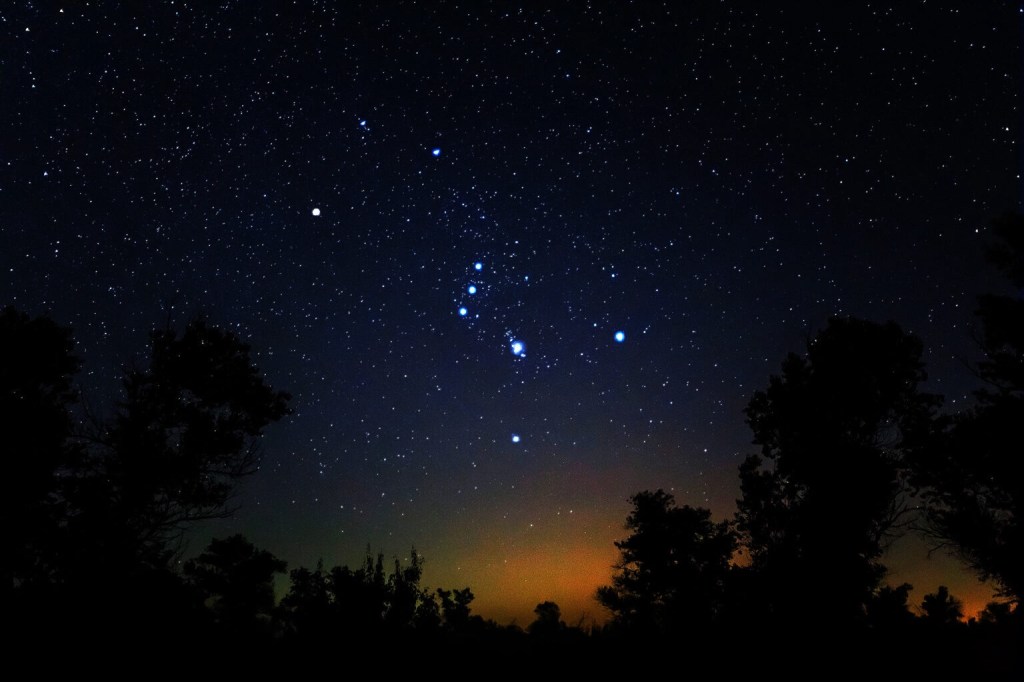
Editor’s Note: A more interesting question may be…will the super-nova explosion of Betelgeuse be part of our near experiences? Just sayin…🌹
——————————————————————-
Next week, the night sky will witness an extraordinary astronomical event, as Betelgeuse, one of the most luminous starsin the constellation Orion, temporarily vanishes from view.
This unusual occurrence, set to happen on Monday night, December 11, is due to an asteroid, 319 Leona, passing directly in front of the star, causing it to disappear for approximately 12 seconds.
Rare occlusion
Astronomical phenomena like this are not uncommon, but the upcoming event involving Betelgeuse is unique due to the specific alignment that will create a striking ‘ring of fire’ effect.
Observers in Florida, parts of eastern Mexico, southern Europe, and northern Asia will be ideally positioned to witness this rare ‘occlusion.’ For those not in these regions, the Virtual Telescope Project in Italy will be streaming the event live from 8 PM Eastern on Monday.
Once-in-a-lifetime opportunity
This brief occlusion is more than just a spectacular sight; it presents a valuable scientific opportunity. Astronomers are eager to use this time to study the surface of Betelgeuse, a red supergiant sun, which has shown unusual dimming patterns over the past four years.
Miguel Montargès, an astrophysicist at the Paris Observatory, expressed excitement about this event, calling it a “once-in-a-lifetime opportunity.” The occlusion will enable scientists to examine the star’s outer region, which is normally overwhelmed by its bright core.
Critical new insights
This research is expected to provide insights into the ‘convective cells’ of Betelgeuse, which are the pathways for heated gas movement across the star. Montargès anticipates that the data gathered might also enhance understanding of how planetary systems, like our own solar system, form.
Gianluca Masi, director of the Virtual Telescope Project, pointed out that the event will also aid in studying asteroid 319 Leona.
“These kinds of occultations,” Masi stated, “are very useful to constrain the shape of the asteroid involved.” He also noted that this occlusion is not only rare but symbolic of Betelgeuse’s eventual fate. “For a very short time, we will see the legendary Orion constellation without its famous, orange shoulder,” referencing the eventual supernova explosion of Betelgeuse.
Viewing the Betelgeuse event
Astronomers are meticulously tracking the trajectory of asteroid 319 Leona, with the occultation anticipated to occur around 8:17 PM Eastern Time. Those within the correct viewing line will have the chance to see Betelgeuse, typically the 10th-brightest star, fade from sight, an experience that can be enhanced with binoculars or a telescope.
Once-in-a-lifetime opportunity
This brief occlusion is more than just a spectacular sight; it presents a valuable scientific opportunity. Astronomers are eager to use this time to study the surface of Betelgeuse, a red supergiant sun, which has shown unusual dimming patterns over the past four years.
Miguel Montargès, an astrophysicist at the Paris Observatory, expressed excitement about this event, calling it a “once-in-a-lifetime opportunity.” The occlusion will enable scientists to examine the star’s outer region, which is normally overwhelmed by its bright core.
Critical new insights
This research is expected to provide insights into the ‘convective cells’ of Betelgeuse, which are the pathways for heated gas movement across the star. Montargès anticipates that the data gathered might also enhance understanding of how planetary systems, like our own solar system, form.
Gianluca Masi, director of the Virtual Telescope Project, pointed out that the event will also aid in studying asteroid 319 Leona.
“These kinds of occultations,” Masi stated, “are very useful to constrain the shape of the asteroid involved.” He also noted that this occlusion is not only rare but symbolic of Betelgeuse’s eventual fate. “For a very short time, we will see the legendary Orion constellation without its famous, orange shoulder,” referencing the eventual supernova explosion of Betelgeuse.
Viewing the Betelgeuse event
Astronomers are meticulously tracking the trajectory of asteroid 319 Leona, with the occultation anticipated to occur around 8:17 PM Eastern Time. Those within the correct viewing line will have the chance to see Betelgeuse, typically the 10th-brightest star, fade from sight, an experience that can be enhanced with binoculars or a telescope.
In summary, Betelgeuse stands as a magnificent example of the wonders of the universe. Its immense size, changing brightness, and inevitable fate as a supernova continue to make it a subject of both scientific study and popular fascination. As we gaze upon this red supergiant, we are reminded of the vastness and beauty of the cosmos.
More about the Orion constellation
As discussed above, the Orion constellation, one of the most recognizable and prominent constellations in the night sky, captivates observers across the globe. Named after the Greek mythological hunter, Orion, this constellation not only boasts significant astronomical importance but also holds a rich cultural and mythological heritage.
Astronomical features of Orion
Orion is home to some of the brightest stars in the night sky. Betelgeuse, the protagonist of this article, marks Orion’s right shoulder. Bellatrix serves as his left shoulder. Rigel, a brilliant blue-white star, represents Orion’s left foot, and Saiph constitutes his right knee. These stars form the distinct hourglass shape of the constellation.
A striking feature of Orion is his belt, comprised of three aligned stars: Alnitak, Alnilam, and Mintaka. Below the belt, the Orion Nebula (M42), a vibrant, star-forming region, dazzles astronomers and astrophotographers alike. This nebula, visible to the naked eye under dark skies, is a popular target for telescopic observation.
Orion in culture and mythology
In Greek mythology, Orion is depicted as a formidable hunter, often associated with tales of bravery and prowess. Various cultures have their own interpretations of this constellation, each adding to its rich narrative tapestry.
The stars of Orion have been significant in various ancient civilizations, from the Egyptians, who associated the constellation with Osiris, the god of the afterlife, to the Native American cultures, where it held various meanings and stories.
In summary, Orion continues to be a source of wonder and inspiration. Its prominent place in the night sky makes it a gateway for amateur astronomers and a subject of ongoing study for professionals. Whether it’s through the lens of science, culture, or mythology, the Orion constellation remains an enduring and captivating presence in our night sky.

