——————————————————————-
Editor’s Note: Highlighted in this article is the question of trust. Who do we trust with our life? In the case below, a human placed his trust on “autopilot”, i.e. giving control over to something/someone not himself.
We are now witnessing the erosion of societal programs we trusted to keep us safe and secure, yet the human mind has “outgrown” the comfort offered by varying levels of control. The personal cost is too great!
So…perhaps it is the moment for you to leave “living on autopilot”, recognize the beauty and sanctity of Who You Are, and then simply BE in…
Quantum Joy!
——————————————————————
The sun had yet to rise in Delray Beach, Fla., when Jeremy Banner flicked on Autopilot. His red Tesla Model 3 sped down the highway at nearly 70 mph, his hands no longer detected on the wheel.
Seconds later, the Tesla plowed into a semi-truck, shearing off its roof as it slid under the truck’s trailer. Banner was killed on impact.
Banner’s family sued after the gruesome 2019 collision, one of at least 10 active lawsuits involving Tesla’s Autopilot, several of which are expected to go to court over the next year. Together, the cases could determine whether the driver is solely responsible when things go wrong in a vehicle guided by Autopilot — or whether the software should also bear some of the blame.
The outcome could prove critical for Tesla, which has pushed increasingly capable driver-assistance technology onto the nation’s roadways far more rapidly than any other major carmaker. If Tesla prevails, the company could continue deploying the evolving technology with few legal consequences or regulatory guardrails. Multiple verdicts against the company, however, could threaten both Tesla’s reputation and its financial viability.

Jeremy Banner. (Family photo)
According to an investigation by the National Transportation Safety Board (NTSB), Banner, a 50-year-old father of four, should have been watching the road on that March morning. He agreed to Tesla’s terms and conditions of operating on Autopilot and was provided with an owner’s manual, which together warn of the technology’s limitations and state that the driver is ultimately responsible for the trajectory of the car.
But lawyers for Banner’s family say Tesla should shoulder some responsibility for the crash. Along with former transportation officials and other experts, they say the company’s marketing of Autopilot exaggerates its capabilities, creating a false sense of complacency that can lead to deadly crashes. That argument is echoed in several Autopilot-related cases, where plaintiffs say they believed Tesla’s claims that Autopilot was “safer than a human-operated vehicle.”
A Washington Post analysis of federal data found that vehicles guided by Autopilot have been involved in more than 700 crashes, at least 19 of them fatal, since its introduction in 2014, including the Banner crash. In Banner’s case, the technology failed repeatedly, his family’s lawyers argue, from when it didn’t brake to when it didn’t issue a warning about the semi-truck in the car’s path.
To reconstruct the crash, The Post relied on hundreds of court documents, dash cam photos and a video of the crash taken from a nearby farm, as well as satellite imagery, NTSB crash assessment documents and diagrams, and Tesla’s internal data log, which the NTSB included in its investigation report. The Post’s reconstruction found that braking just 1.6 seconds before impact could have avoided the collision.
Friday, March 1, 2019, starts like any workday for Banner, a software engineer who heads to work in his 2018 Tesla Model 3 around 5:50 a.m.
At 6:16 a.m., Banner sets cruise control to a maximum of 69 mph, though the speed limit on U.S. 441 is 55. He turns on Autopilot 2.4 seconds later.
A standard Autopilot notice flashes on the screen: “Please keep your hands on the wheel. Be prepared to take over at any time.”
According to Tesla’s user documentation, Autopilot wasn’t designed to work on a highway with cross-traffic such as U.S. 441. But drivers sometimes can activate it in areas and under conditions for which it is not designed.
Two seconds later, the Tesla’s data log registers no “driver-applied wheel torque,” meaning Banner’s hands cannot be detected on the wheel.
If Autopilot does not detect a driver’s hands, it flashes a warning. In this case, given Banner’s speed, the warning would have come after about 25 seconds, according to the NTSB investigation.
Banner does not have that long.
From a side road, a truck driverbegins to cross U.S. 441, slowing but failing to fully stop at a stop sign.
The truck enters the Tesla’s lane of traffic
Two seconds later — just before impact — the Tesla’s forward-facing camera captures this image of the truck.
The car does not warn Banner of the obstacle. “According to Tesla, the Autopilot vision system did not consistently detect and track the truck as an object or threat as it crossed the path of the car,” the NTSB crash report says.
The Tesla continues barreling toward the tractor-trailer at nearly 69 mph. Neither Banner nor Autopilot activates the brakes.
Two seconds later — just before impact — the Tesla’s forward-facing camera captures this image of the truck.
The car does not warn Banner of the obstacle. “According to Tesla, the Autopilot vision system did not consistently detect and track the truck as an object or threat as it crossed the path of the car,” the NTSB crash report says.
The Tesla continues barreling toward the tractor-trailer at nearly 69 mph. Neither Banner nor Autopilot activates the brakes.
The Tesla slams into the truck, and its roof is ripped off as it passes under the trailer. Banner is killed instantly.
The Tesla continues on for another 40 seconds, traveling about 1,680 feet — nearly a third of a mile — before finally coasting to a stop on a grassy median.
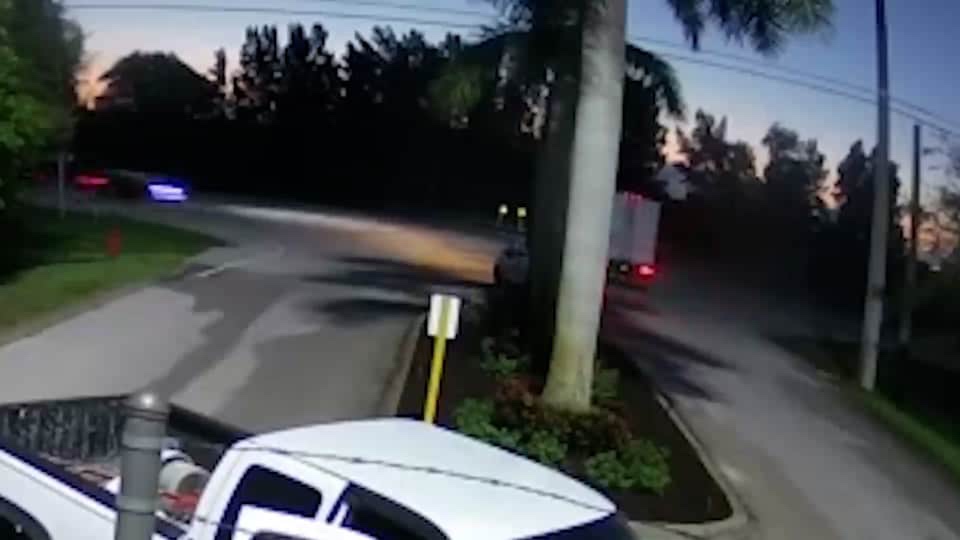
A surveillance video located on the farm where the truck driver had just made a routine delivery shows the crash in real time. This video, which was obtained exclusively by The Post, along with court documents, crash reports and witness statements, offers a rare look at the moments leading up to an Autopilot crash. Tesla typically does not provide access to its cars’ crash data and often prevents regulators from revealing crash information to the public.
Braking even 1.6 seconds before the crash could have avoided the collision, The Post’s reconstruction found by reviewing braking distance measurements of a 2019 Tesla Model 3 with similar specifications, conducted by vehicle testers at Car and Driver. At this point the truck was well within view and spanning both lanes of southbound traffic.
Due to the uncertainty of Banner’s movements in the car, The Post did not depict him in the reconstruction. The NTSB investigation determined that Banner’s inattention and the truck driver’s failure to fully yield to oncoming traffic were probable causes of the crash.
However, the NTSB also cited Banner’s “overreliance on automation,” saying Tesla’s design “permitted disengagement by the driver” and contributed to the crash. Four years later, despite pleas from safety investigators, regulators in Washington have outlined no clear plan to address those shortcomings, allowing the Autopilot experiment to continue to play out on American roads, with little federal intervention.
While the Federal Motor Vehicle Safety Standards administered by the National Highway Traffic Safety Administration (NHTSA) spell out everything from how a car’s brakes should operate to where its lights should be located, they offer little guidance about vehicle software.
‘Fancy cruise control’
Teslas guided by Autopilot have slammed on the brakes at high speeds without clear cause, accelerated or lurched from the road without warning and crashed into parked emergency vehicles displaying flashing lights, according to investigation and police reports obtained by The Post.
In February, a Tesla on Autopilot smashed into a firetruck in Walnut Creek, Calif., killing the driver. The Tesla driver was under the influence of alcohol during the crash, according to the police report.
In July, a Tesla rammed into a Subaru Impreza in South Lake Tahoe, Calif. “It was, like, head on,” according to a 911 call from the incident obtained by The Post. “Someone is definitely hurt.” The Subaru driver later died of his injuries, as did a baby in the back seat of the Tesla, according to the California Highway Patrol.
Tesla did not respond to multiple requests for comment. In its response to the Banner family’s complaint, Tesla said, “The record does not reveal anything that went awry with Mr. Banner’s vehicle, except that it, like all other automotive vehicles, was susceptible to crashing into another vehicle when that other vehicle suddenly drives directly across its path.”
Autopilot includes features to automatically control the car’s speed, following distance, steering and some other driving actions, such as taking exits off a freeway. But a user manual for the 2018 Tesla Model 3 reviewed by The Post is peppered with warnings about the software’s limitations, urging drivers to always pay attention, with hands on the wheel and eyes on the road. Before turning on Autosteer — an Autopilot feature — for the first time, drivers must click to agree to the terms.
In particular, Tesla noted in court documents for the Banner case that Autopilot was not designed to reliably detect cross-traffic, or traffic moving perpendicular to a vehicle, arguing that its user terms offers adequate warning of its limitations.
In a Riverside, Calif., courtroom last month in a lawsuit involving another fatal crash where Autopilot was allegedly involved, a Tesla attorney held a mock steering wheel before the jury and emphasized that the driver must always be in control.
Autopilot “is basically just fancy cruise control,” he said.


THIS IS MY PERSONAL OPINION REGARDING THE ACCIDENT CAUSED BY A STUPID DRIVER WHO USE THE AUTOPILOT SWITCH.
FIRST OF ALL LAWYERS/ATTORNEYS ARE TO ME NOTHING MORE THAN PREDATORS, WHO LOVE, TO MAKE LOTS OF MONEY THE EASYWAY.
THEY DO NOT LIKE TO TAKE COMPLICATED CASES AGAINST GOVERNMENT OR BIG CORPORATIONS UNLESS THE CASE INVOLES ACCDENTS AIRPLANE ACCIDENTS OR CAR ACCIDENTS.
AUTOPILOTS ARE NOTHING NEW WHEN IT COMES TO TECHNOLOGY THAT HAS BEEN USED ON JUST ABOUT ALL MOTOR VEICLES, SPECIALY THE MORE EXPENSIVE ONES AND ONLY LAZY PEOPLE LIKE TO USE AUTOPILOT ON REGULAR BASIS.
EVEN COMERCIAL TRACTOR TRAILER HAVE AUTOPILOT AS AN OPTION FOR DRIVERS TO USE. SPECIALY ON LONG HAULS CROSS COUNTRY, WHEN DRIVERS GET TIRED OF KEEPING THEIR FOOT DOWN TO THE METAL FOR HOURS ON END.NOT WISE TO USE AUTOPILOT ON REAL BUSY ROADS, HIGHWAYS, WITH CROSSROADS ALONG THE WAY, AUTOPILOT WAS INVENTED FOR USE ON FREEWAYS OPEN ROAD BUT AT SPEED LIMITS ON SUCH ROADS OR LOWER SPEEDS.
THIS STUPID DRIVER WAS GOING 69 MPH, ON A 55 SPEED LIMIT, TESLA CAN NOT BE FOUND GUILTY OF SUCH STUPID MISTAKE BY A DUMB DRIVER.
AND THE OTHER ONE THAT WILL ALSO BE FOUND GUILTY WILL BE THE TRUCK DRIVER AND TRUCKING COMPANY HE WAS DRIVING FOR,
AS AN EX-COMMERCIAL DRIVER MYSELF KNOW THAT TRUCKING COMPANIES PUT A LOT OF PRESSURE ON STATE DELIVERIES, TO THE DRIVERS, BY THE WAY THE COMPANIES DO THE SCHEDULING OF DELIVERY, IF DRIVER HAS TO DO A NUMBER OF DELIVERIES PER DAY, WITH A TRUCK LOADED WITH SEVERAL STOPS CAN PUT ANY DRIVER OUT OF SCHEDULE DUE TO THE RECIVERS AT THE MANY UNLOADING PLACES THE DRIVER HAS TO DO, REASON WHY THIS PARTICULAR DRIVER DID NOT MAKE A FULL STOP AT THE STOP SIGN, THAT WILL CAUSE HIM HIS JOB AND POSIBLY JAIL TIME FOR NEGLIGENCE, TO STOP AND MAKE SURE THERE WAS NO CAR COMMING BEFORE CROSSING THE ROAD.
1.6 SECONDS WOULD HAVE NEVER STOP THE CAR AT 69 MPH. PERIOD THE CAR WOULD HAVE CONTINUE SLIDING THOWARDS THE TRAILER GOING AT THAT SPEED,
SO, BOTH DRIVERS WERE GUILTY OF NEGLIGENCE.
AND BOTH COMPANIES MAY END UP PAYING FOR TWO IRRESPONSIBLE DRIVERS BEHIND THE WHEEL.
THAT IS WHAT HAP[PENS FOR ALL THOSE PEOPLE THAT LOVE NEW TECHNOLOGY IT COMES WITH LOTS OF RISKS.
NOW FOR ALL THOSE THAT ARE RIGHT NOW CHEERING FOR 2025 WHEN TECHNOLOGY WILL PERMIT THEM TO FLY OVER THE HIGHWAYS, TO AVOIKD TRAFIC, JUST WAIT AND SEE HOW MANY STUPID DRIVERS WILL END UP DYING ON CRASHES ALL OVER THE UNITED STATES TRYING TO GET TO WHEREVER THEY ARE GOING BY FLYING THEIR NEW TOYS.
SO ALL OF YOU CAN MOVE AHEAD ON YOR ILLUSION OF MOVING FORWARD TO AS MANY HIGHER DIMENTIONS AS YOU CARE TO CLIMB.
I WILL STAY RIGHT HERE WHERE GOD PUT ME WITH MY FEET GROUNDED ON EARTH ON THE 4TH DIMENTION.
DRIVING A 1950’S CAR WITH OUT AUTOPILOT, OR A 1960’S CAR OR TRUCK.
I WILL ENJOY MYSELF GREATLY DRIVING OLD CARS WITHOUT ALL THOSE DAMN CHIPS THAT ANY ONE CAN CONTROL YOUR CAR BY WAY OR CONTROL REMOTE AS THEY HAVE DONE WITH MANY PEOPLE THAT ENDS UP KILLING LOTS OF PEOPLE AS THE DRIVERS LOSE CONTROL OF THEIR CARS DO TO A CRIMIANL MINDED JEW THAT HAS CONTROL OF THEIR CAR BYWAY OF REMOTE CONTROL.
TRUCKING COMPANY MORE LIKLY WILL BE THE ONE HIT THE HARDEST BY LAW SUITES, THEY LOVE TO DESTROY TRUCKING COMPANIES AS MUCH AS POSIBLE THAT GET MIXED UP IN MOVING ACCIDENTS, BY NEGLIGENT DRIVERS.
LikeLike
Hey Crapgiver..
This lady is really special…I thought you might like this and she did a second video as well. Her second video link is in the description of this video.
Virginia Drake
Near Death Experience…(she talks about being with Jesus and so much more)
LikeLike
Many thanks! LOVE your shares!! 😊💕🌹
LikeLike
I agree with avoiding autopilot! So many put their lives on “autopilot”! 😊🌹
LikeLike
MUSE:
WHY DID YOU FELT I WANTED TO SEE THIS PARTICULAR VIDEO?
LikeLike
WEll, I thought of you when I watched it. She talks about speaking with Jesus and about the Bible…so I thought you might get something out of it because she explains how to work out your fear, especially of death and she talks about God and so on…maybe it can help you…that’s all.
LikeLike
😊🌹
LikeLike
🌹😊
LikeLike