______________________________________________________________________________________________
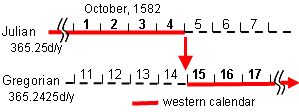
The Julian Calendar was the system of dating followed from 46BC onwards. It was this calendar which added one extra day in every four years (giving us our ‘leap year’) because it had been calculated that the earth takes 365¼ days to complete its circuit around the sun, not a straight 365 days.
Unfortunately, this calculation was not entirely accurate. In fact, the sun’s circuit is not exactly 365¼ days – it’s approximately 11 minutes less. This may seem a very small amount, but over a large number of years the figure builds up. As a result, it emerged that the Julian Calendar was over-correcting by around 8 days each millennium.
In the 16th century the problem was examined. A solution was hit upon whereby centenary years would not be leap years unless they were divisible by 400. This meant that three out of four centenary years would not be leap years, or, that in every 400 years there would not be 100 leap years but 97. Using this calculation meant that there would only be an over-correction of 23 seconds, and that it would take 3,700 years before the over-correction amounted to a full day.
In 1582 Pope Gregory ruled that this new calendar – thereafter called the Gregorian Calendar – should be brought into use. By that stage, the Julian Calendar had added ten days too many to the calendar, so Pope Gregory decreed that the day after the 4th of October 1582 should be the 15th of October 1582, thus correcting the error.
Unfortunately for historians, the new calendar was not adopted universally – different countries began to follow it at different dates. The main dates of introduction are as follows:
| Country | Date new calendar adopted |
|---|---|
| Italy | 1582 |
| France | 1582 |
| Spain | 1582 |
| Portugal | 1582 |
| Prussia | 1583 |
| Flanders | 1583 |
| Poland | 1586 |
| Hungary | 1587 |
| Netherlands | 1700 |
| Denmark | 1700 |
| Sweden | 1700-1740 (gradually, by omission of leap years) |
| Great Britain | 1752 |
| America | 1752 |
| Japan | 1872 |
| China | 1912 |
| Bulgaria | 1915 |
| Turkey | 1917 |
| Russia | 1917 |
| Yugoslavia | 1919 |
| Romania | 1919 |
| Greece | 1923 |
In Great Britain, the new calendar was adopted in September 1752. In order to deal with the discrepancy of days, which by now had grown to eleven, it was ordered that 2nd September 1752 would be immediately followed by 14th September 1752. This led to crowds of people on the streets demanding, ‘Give us back our 11 days!’ It also explains why our financial year begins on 6th April. The official start of the year used to be Lady Day (25th March), but the loss of eleven days in 1752 pushed this back to 5th April. Another skipped day in 1800 pushed it back again to 6th April.
Users beware!
Because of this discrepancy in the date of adoption, documents written on the same day in different countries may carry different dates. In correspondence between Britain and France between 1582 and 1752, for instance, there would be a discrepancy of 10 or 11 days between the two calendars. Therefore, the 10th of November 1583 in Britain (Julian calendar) was the 20th of November 1583 in France (Gregorian calendar). What this meant in practice was that a reply written in Britain to a letter sent from France could apparently be dated from before the original was sent!
For example, a letter written in France on the 22nd of April 1660 (Gregorian) could well be replied to in England on the 15th of April 1660 (Julian – actually the 25th of April in the Gregorian Calendar).
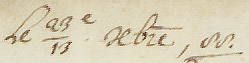
This helps to explain why this document, a list relating to orders for the march of the Dutch army, was dated the 23/13 December 1688. The date was the 23rd of December on the Continent, reckoned according to the Gregorian Calendar, but the 13th of December in Britain, reckoned according to the Julian Calendar.
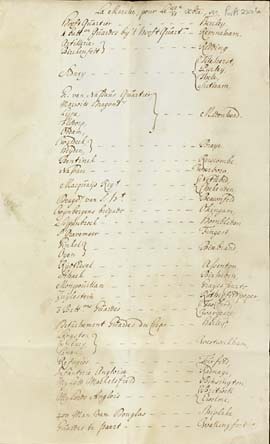
Orders for the march of the Dutch army, 1688 (Pw A 2226) with detail below
The following table will assist in making conversions from the Julian to the Gregorian Calendars:
- After 5th October 1582 add ten days to the Julian Calendar
- After 28th February 1700 add eleven days to the Julian Calendar
- After 28th February 1800 add twelve days to the Julian Calendar
- After 28th February 1900 add thirteen days to the Julian Calendar

