______________________________________________________________________________________________

China has issued the highest typhoon warning as Typhoon Saola crawled closer to the south-eastern coastline, threatening Hong Kong and other major manufacturing hubs in neighbouring Guangdong province.
Chinese forecasters issued a typhoon red warning at 6am on Thursday. China’s National Meteorological Centre said Saola, which lies about 295km (183 miles) south-east of Guangdong province, will move north-west across the South China Sea at a speed of about 10km/h (6mph), gradually approaching the coast of Guangdong, then slowly weaken in intensity.
Wind speeds at 9am were clocked at 209km/h.
The typhoon passed by the Philippines earlier this week, without any reports of casualties so far.
However, in the northern part of the islands, the typhoon’s torrential rains and fierce winds enhanced seasonal monsoon rains, flooding low-lying villages and displacing nearly 50,000 people, including 35,000 villagers who fled to government-run evacuation centres. Seaports suspended inter-island ferry services due to rough seas, and more than a hundred houses were damaged.
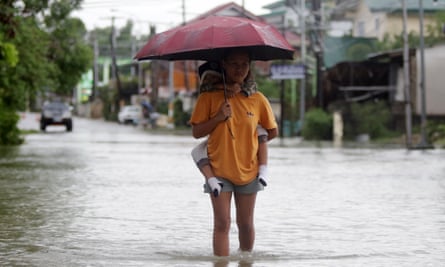
A woman carrying a child wades through floodwaters in the town of Paoay, Ilocos Norte, Philippines on Wednesday. Photograph: Bernie Sipin Dela Cruz/EPA
Saola will make landfall in China along the coast somewhere from Huilai County in Guangdong to Hong Kong between Friday afternoon and Friday night, the centre said.
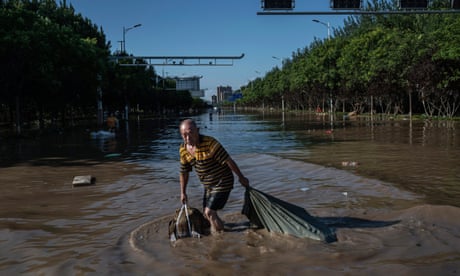
China Railway has suspended several major train lines and Shanghai halted trains heading to Guangdong, according to local media.
As Saola edges closer to Guangdong, winds over the region will strengthen gradually, the Hong Kong Observatory said, noting that it will raise its strong wind Signal to No 3 – the second lowest – later Thursday.
Saola will also bring storm surges to coastal low-lying areas, the Hong Kong Observatory noted, estimating Saola is currently about 440km (270 miles) from the metropolis.
Until 8am on Friday there will be heavy rainfall in parts of Fujian and areas of Guangdong. Downpours could be 100-220mm (3.9 inches to 8.7 inches) in some areas.
Saola’s winds are also affecting Fujian province, where videos on social media showed waves crashing along the coastline. The meteorological administration of Shishi city issued a typhoon blue warning.
The country has been hit by heavy rain and flooding over the past two months, including that brought by Typhoon Doksuri at the end of July.
The deadly storm, one of the strongest to hit the country in years, left a trail of destruction, triggering the evacuation of more than 30,000 people from Beijing, and causing severe flooding in the capital and Fujian.
Reuters and Associated Press contributed to this report
I hope you appreciated this article. Before you move on, I was hoping you would consider taking the step of supporting the Guardian’s journalism.
From Elon Musk to Rupert Murdoch, a small number of billionaire owners have a powerful hold on so much of the information that reaches the public about what’s happening in the world. The Guardian is different. We have no billionaire owner or shareholders to consider. Our journalism is produced to serve the public interest – not profit motives.
And we avoid the trap that befalls much US media – the tendency, born of a desire to please all sides, to engage in false equivalence in the name of neutrality. While fairness guides everything we do, we know there is a right and a wrong position in the fight against racism and for reproductive justice. When we report on issues like the climate crisis, we’re not afraid to name who is responsible. And as a global news organization, we’re able to provide a fresh, outsider perspective on US politics – one so often missing from the insular American media bubble.
Around the world, readers can access the Guardian’s paywall-free journalism because of our unique reader-supported model. That’s because of people like you. Our readers keep us independent, beholden to no outside influence and accessible to everyone – whether they can afford to pay for news, or not.

