______________________________________________________________________________________________
The cracks in commercial real estate widen … a billionaire real estate investor sounds the alarm … tracking the daisy chain of defaults … the flip side will be enormous opportunity
There are many green shoots in today’s broad economic landscape. They’re encouraging, and we remain committed to trading this bull market higher.
But the way we protect our wealth is by paying more attention to weeds than green shoots.
And if you’re looking for weeds today, just type “commercial real estate” into Google.
Here are the headlines that populated my results (all from within just the last few days):
– Commercial Property Investors’ Huge Office Bet is Unraveling in London, New York – Bloomberg
– Commercial real estate may not recover until 2024, with low-occupancy, high-cost cities like New York and San Francisco hit hardest – Fortune
– Record Miami Land Sales Collapses Amid Commercial Real-Estate Slowdown – Wall Street Journal
– The source of remote work sends U.S. office distress up to $24.8 billion – that’s even worse than malls and hotels – Fortune
– San Francisco Commercial Property Values May Fall 40% by 2025 – The San Francisco Standard
– Commercial Property Distress Hits $71B in Q2, Led By Office – Bisnow
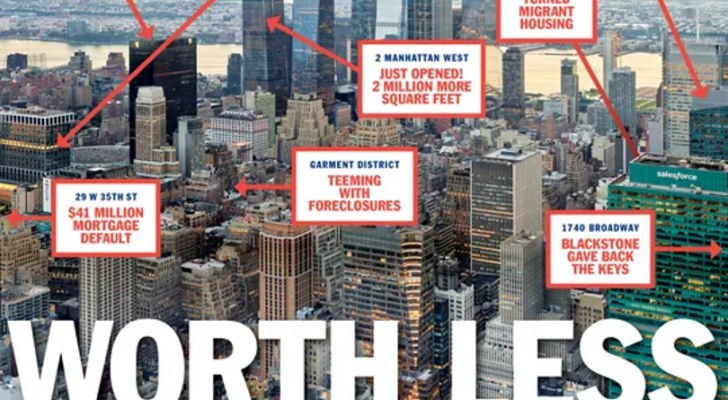
Below is the July cover of New York Magazine. If you’re having trouble reading the slug line, it reads:
“Manhattan’s office buildings are dangerously empty and crushed by debt, and their owners are in over their heads.”
The cracks in commercial real estate widen … a billionaire real estate investor sounds the alarm … tracking the daisy chain of defaults … the flip side will be enormous opportunity
There are many green shoots in today’s broad economic landscape. They’re encouraging, and we remain committed to trading this bull market higher.
But the way we protect our wealth is by paying more attention to weeds than green shoots.
And if you’re looking for weeds today, just type “commercial real estate” into Google.
Here are the headlines that populated my results (all from within just the last few days):
– Commercial Property Investors’ Huge Office Bet is Unraveling in London, New York – Bloomberg
– Commercial real estate may not recover until 2024, with low-occupancy, high-cost cities like New York and San Francisco hit hardest – Fortune
– Record Miami Land Sales Collapses Amid Commercial Real-Estate Slowdown – Wall Street Journal
– The source of remote work sends U.S. office distress up to $24.8 billion – that’s even worse than malls and hotels – Fortune
– San Francisco Commercial Property Values May Fall 40% by 2025 – The San Francisco Standard
– Commercial Property Distress Hits $71B in Q2, Led By Office – Bisnow
Below is the July cover of New York Magazine. If you’re having trouble reading the slug line, it reads:
“Manhattan’s office buildings are dangerously empty and crushed by debt, and their owners are in over their heads.”
In last Thursday’s Digest, we profiled the “economic hurricane” headed our way. Namely, trillions of dollars of low-cost corporate debt are maturing over the next three years that will have to be refinanced at today’s significantly higher interest rates. This will cause enormous financial pain.
Legendary investor Warren Buffett once quipped, “You only find out who is swimming naked when the tide goes out.” Well, with the Fed nearly certain to raise rates to 5.25% – 5.50% on Wednesday and hold them there, and $1.4 trillion in commercial real estate debt coming due by the end of next year, the tide is going out. And no sector has more “naked swimmers” than commercial real estate.
Given this, regular Digest readers know that for months, we’ve been running a “commercial real estate watch” segment to monitor this critically important sector of the U.S. economy.
The same factors that resulted in a handful of banking failures this spring are creating cracks in the foundation of the $20-trillion commercial real estate sector. If defaults snowball, it will have an enormous domino-effect on the U.S. economy. Our latest story for our “Watch” segment features billionaire real estate investor Barry Sternlicht
Though not the household name of say, Warren Buffett or Paul Tudor Jones, Sternlicht is a legend in his own right. He made a name for himself as a real estate bargain hunter who scooped up distressed assets during financial meltdowns (he was a buyer in the aftermath of the US savings and loan collapse, and later, in the Great Financial Crisis). He’s now the Chairman of Starwood Capital Group, which has $115 billion in assets under management.
If anyone has a pulse on the commercial real estate sector, it’s Sternlicht. As to that pulse, here’s his conclusion:
We’re in a Category 5 hurricane.
It’s sort of a blackout hovering over the entire industry until we get some relief or some understanding of what the Fed’s going to do over the longer term.
Let’s jump to the Bloomberg article featuring an interview with Sternlicht:
Financing now is more expensive and harder to come by. Landlords with floating-rate loans are facing the prospect of higher debt payments…
In the meantime, tight credit conditions are complicating developers’ efforts to start projects or refinance existing buildings. In one recent example, Starwood reached out to 33 banks for a loan on a small property and received just two offers, Sternlicht said.
Lenders are also reluctant to take possession of struggling assets. In one case where Starwood tried to surrender an office building, the lender instead offered to restructure the loan.
In explaining the problem facing his company and other real estate outfits, Sternlicht explains that Starwood’s loans feature interest-rate caps. But those caps will be expiring. And when they do, thanks to the Fed’s rate hikes, instead of paying 1% or 2%, they’ll be paying 8% of 9%.

