______________________________________________________________________________________________
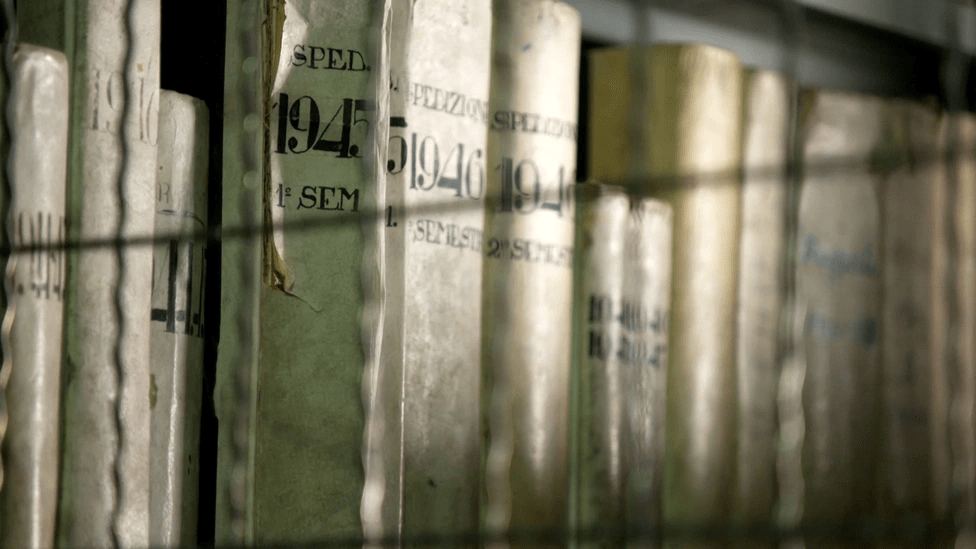
Today, after decades of controversy over Pope Pius XII’s failure to condemn the mass murder of Europe’s Jews during the Second World War, the Vatican archives covering his papacy are at last open to researchers. Pius XII—born Eugenio Pacelli—is reviled by some for his failure to speak out against the Holocaust. He is venerated by others who have been promoting him for sainthood. His long papacy, stretching from 1939 to 1958, remains the subject of intense debate. For those of us who have been trying for years to make our way past the thicket of polemics surrounding the pope—and to capture the role the Vatican played during the war—the sense of anticipation is great.
The issues the newly opened archives will shed light on are not only of historical interest. The traumas of the Second World War and of the Holocaust remain very much alive. Holocaust denial might be dismissed as the delirium of a crackpot fringe, but denial of responsibility for the war and for the Holocaust remains widespread in Europe and in the Christian churches.
David I. Kertzer: The secrets that might be hiding in the Vatican’s archives
Media interest in the opening of the archives has been intense. A huge throng of journalists from all over the world packed the Vatican press room on February 20 for a briefing. Scholars crowded into a Vatican workshop held the next day to explain how the mass of documents has been organized and how it can be accessed. Those of us who have written about the papacy and the war have been besieged with interview requests.
The documents that are now available cover the entire papacy of Pius XII. Yet in presenting the archives to the public, Bishop Sergio Pagano, prefect of the Vatican Apostolic Archive (known until recently as the Vatican Secret Archive), underscored what he said would be revealed about the pope’s actions during the war. That the Vatican is especially sensitive to what light the documents might shed on the controversy over the pope’s silence during the Holocaust was clear from the initial interview that Pagano gave Radio Vatican on February 20. “Obviously the dramatic question of the Shoah and therefore of the Jews immediately appears,” he acknowledged. “We know the history of this persecuted people and of the Shoah, and therefore we very much understand that the Jews are expecting a great deal from these documents.”
Don’t miss what matters. Sign up for The Atlantic Daily newsletter.Email Address
Readers of the major Italian newspapers in recent weeks could hardly fail to notice the sudden appearance of full-page articles describing what were said to be Pius XII’s heroic efforts to thwart the Nazis and protect the Jews. “Vatican: Over Six Thousand Jews in Rome Were Saved Thanks to the Action of Pius XII” was a January 28 headline in Rome’s major daily paper, Il Messaggero. Oddly, the article offered no evidence of any action taken by the pope to this effect.
Two days later, one of Italy’s leading national newspapers, La Repubblica, published a breathless article headlined“Thus Mussolini Tried to Stop Pope Pacelli.” The subhead read: “Documents from the (formerly Secret) Vatican Archive show the attempts to interfere in the conclave that elected Pius XII: ‘He is too political a figure and inclined to have a democratic mentality.’” The author claimed that a document in the about-to-be-opened archives showed that the Fascist leadership worked feverishly to prevent the election of Eugenio Pacelli to the papacy. That the article—which took up more than a page—was carried in the country’s most prominent left-leaning daily was especially notable. Not even Pius XII’s most fervent admirer would seriously argue that he had ever had a “democratic mentality.” The pope was most comfortable with authoritarian regimes and decidedly uncomfortable with multiparty democracies. Anyone truly wanting to understand the role that Benito Mussolini’s regime played in advance of the conclave that elected Pacelli would look not in the Vatican archives but in the Fascist archives. In fact, Italian diplomatic correspondence indicates that the Italian ambassador to the Holy See favored Pacelli’s election and, together with the similarly inclined German ambassador, lobbied the cardinals on Pacelli’s behalf.
Yet another puff piece appeared in mid-February in Turin’s major newspaper, La Stampa, titled “Pius XII’s Secret Plan Against Hitler.” Newly available Vatican documents, the article claimed, reveal that Hitler wanted to invade the Vatican and kidnap the pope, but that the Vatican’s 200 gendarmes had secretly organized to foil the plot. In fact, German troops had occupied Rome and conducted a nine-month reign of terror. If Hitler had given the order to seize the Vatican and kidnap the pope, the task might have taken an hour to accomplish, notwithstanding the poorly armed papal gendarmes blocking the way. What an article such as this obscures are the cordial relations that the Vatican enjoyed with the German occupying forces. The pope had an interest in ensuring the integrity of Vatican City. The Germans, for their part, realized the public-relations value in trumpeting a respectful attitude toward the pope and the Holy See.
Millions of pages of Vatican documents are now available. Many are lodged in various archives in Vatican City. Others are elsewhere in Rome. But not all of the Church’s wartime archives are immediately accessible. Still unclear is the status of various archives that are crucial for reconstructing the history of the wartime period, but that do not come directly under Vatican control. Notable among them are the central Jesuit archives, a stone’s throw from the Vatican, as well as the archives of the vicariate of Rome, on the other side of the Tiber. Given that the pope himself is a Jesuit—and, as bishop of Rome, has authority over the vicariate—some scholars assumed that these two archives would be opened at the same time as those of the Holy See. So far there has been no indication that they will be. A massive corpus of papers about relations between the Vatican and the Italian Fascist regime are lodged in the Jesuit archives.
Likewise, a fuller understanding of the Church’s actions during the German occupation of Rome depends on what may be found in the vicariate archive. Yet there is reason for worry, if my own experience is any guide. I wrote a book more than two decades ago about a small Jewish boy, Edgardo Mortara, taken on orders of the Inquisition from his family in Bologna in 1858. Bologna was then part of the Papal States, and someone had secretly baptized the child. According to Church policy at the time, such a child could not remain with his Jewish family. He was brought to the House of Catechumens, the Church institution in Rome dedicated to the conversion of the Jews. Its records are housed in Rome’s vicariate archives. Not only did the director of the archives refuse me access to the Mortara records when I was writing that book; he has continued to refuse access, not only to me but to other scholars. If an uncomfortable 19th-century case can lead to such stonewalling, what might the attitude be toward the much more fraught case of the Church’s actions during the Nazi occupation?
Bishop Pagano was quoted by Milan’s Corriere della Sera as saying that only poorly prepared researchers will be looking for “scoops” in the first days or weeks after the opening of the archives. “A serious scholar,” he said, “must plan on spending at least ten years of study.” With the sheer size of the archives, and a daily limit on the number of files a scholar is permitted to view, there is no question that the full scope of what the archives reveal will not be known for many years. Yet those of us who have already spent decades plumbing what was already available—such as the frequent wartime reports from the Vatican sent home by the Italian, German, French, British, and American envoys to the Holy See, not to mention the copious reports written by Mussolini’s spies in the Vatican—may glean important new understanding of this much-contested history before too long.
The issues are many. The question most often posed, regarding the pope’s silence during the Holocaust, is itself part of a larger issue: the pope’s reluctance to publicly condemn Nazi Germany. From the very first days of the war, with Germany’s invasion of Poland in September 1939, the pope was under great pressure to speak out on behalf of heavily Catholic Poland. That he refused to condemn the Germans for the invasion was only the first of many similar moments about which the Vatican documents promise to provide insight. There is also the question of Italy’s own merciless campaign against the Jews. Some scholars have made an unflattering comparison between the outbursts by Pius XI, Pacelli’s predecessor, against Mussolini’s “racial” campaign, which began in 1938, and Pius XII’s failure to speak out against it—ever. What will the Vatican archives reveal about discussions inside the Vatican regarding the persecution of Italy’s Jews, which the Fascists were justifying in no small part as simply putting into practice restrictions on the Jews long urged by the popes?
Most dramatic of all was the Nazi-military encirclement of Rome’s ancient ghetto on October 16, 1943, and the extraction from their homes of more than 1,000 of the city’s Jews, mainly women and children. They were held for two days in a military complex close to the Vatican. The pope could have called publicly for their release. He could have sent a private message to Hitler, pleading on their behalf. He did neither. The Jews were put on a train that would take them to Auschwitz and to their deaths. What might the Vatican archives tell us about the discussions within the Vatican leading to the pope’s decision not to intervene?
Public attention, naturally enough, is focused on the war years. But the postwar years are likely to provide their own surprises and insights. In Europe, this was a tense and eventful time. Of special interest is the drama of postwar Italy—its cities in ruins, its king disgraced, its society riven by acute tensions as former Fascist persecutors lived uneasily alongside those they had tormented. The Communist Party was growing rapidly. The Church played a crucial and well-known role in blocking the Communists. But just how the pope conducted his behind-the-scenes campaign remains in good part unknown. And then there is the role the Vatican played in helping Nazi and Fascist war criminals escape to countries like Argentina. That the so-called ratline, which depended on Church institutions and high Catholic prelates, was in operation is hardly disputed among scholars. But how did it operate? What did the Vatican know about it? Did anyone there try to stop it?
The questions that researchers can now probe more deeply are all too topical today. The term fascism is much bandied about in reference to major parties and leaders in various parts of the world, not to mention its frequent use in characterizing America’s own would-be strongman. These analogies are easily dismissed as polemical overreach. Yet the opening of the Vatican archives offers a timely opportunity to take a new look at the classic question of how fascism arises in democratic societies, as it did in Italy and Germany. No less urgent is the task of understanding the influential role that religious leaders played then, and play now, in supporting authoritarian leaders. In reflecting today, too, on how hatred of the “other” is generated, the role that religion plays, whether in Christian, Muslim, Hindu, or Jewish societies, remains an uncomfortable but necessary question. The mass murder of Europe’s Jews in mid-20th-century Europe, and the role played by the Christian churches in the demonization of the Jews, remains the inescapable exemplar.


The Vatican horded ancient writings and artifacts…and obvious knowledge of the ET factor, worshipped Lucifer and right under everyone’s nose. I could see it but how in the heck did no one else see this about them. Not to mention the priests that went out to all the churches and were pedos preying on children, and nothing was done to them….Can’t wait to see what is in their vault…it’ll be interesting, perhaps the truth on why they have all those telescopes and pretty sure we can guess why…LOL
Snake room and the sculpture that sits behind them on the stage…does no one see that? LOL
https://www.soulask.com/inside-the-popes-reptilian-audience-hall-in-vatican-city/#:~:text=Designed%20by%20award-winning%20Italian%20architect%20Pier%20Luigi%20Nervi%2C,in%20front%20of%20a%20giant%20Satanic%20looking%20sculpture.
LikeLike
Ewww…thanks! 🌹😊💕
LikeLike
@muse
The telescopes probably for keeping an eye out for the good aliens, a warning system, as it were.
LikeLike
Could be true! 🌹😊
LikeLike
LOL, the Vatican don’t do good things….and don’t look for ‘good’ aliens, give me a break! They were waiting for their ‘gods’ to return, The Watchers perhaps…the ancient gods…
LikeLike
Naw, they trying out for the good aliens, because when they show up, “Game over man, game over!”, as Hudson would say.
LikeLike
🌹😊
LikeLike
Yes, yes, yes! They will be here soon…!🌹💕😊
LikeLike
LOL, yeah game over with the good aliens but the Vatican ain’t part of that, it’s a bunch of pedos in robes getting rich off religion and human guilt. Hoarders of humanity’s wealth, history and they worship Lucifer…ain’t nothing good about them.
LikeLike
You got that right! 💕😊🌹
LikeLike
Sounds plausible…the Vatican is extremely interested in astronomy! Just as NASA really likes numerology& magic! Dark use of these arts…🌹😊💕
LikeLike
That’s why the Vatican’s looking for the aliens, as a warning system, since the aliens will kick their asses upon arrival.
LikeLike
Now that is somethng I’d like to see…all the pedos getting their asses kicked off this planet and out of their human looking bodies.
LikeLike
Yes, yes, yes! 🌹😊💕
LikeLike
Yes, yes, yes! 🌹💕😊
LikeLike