SYDNEY’S LONGEST SPELL OF DAYS BELOW 30C IN 140-YEARS; COLDEST START TO A YEAR SINCE 1982 IN SÃO PAULO, BRAZIL; + HISTORIC SNOW IN WESTERN U.S. HELPS DRIVE NORTHERN HEMISPHERE SNOW MASS *FURTHER* ABOVE 1982-2012 AVERAGE
SYDNEY’S LONGEST SPELL OF DAYS BELOW 30C IN 140-YEARS
It was a cold 2022 across Australia, with many daily, monthly and even all-time records felled — 2023 has started in the same chilly vein.
Sydney is on the verge of recording its longest spell of days below 30 degrees Celsius (86F) in 140 years, since 1883.
The Harbour City has warmedsince its pre-Christmas record cold spell, but Tuesday’s maximum of 26.6C at Observatory Hill marked the 323rd consecutive day under 30C — already the longest stretch in three decades.
And with daily highs forecast to remain comfortably below 30C for the remainder of the week, the run of sub-30C days will be extended to at least 327 — the most since the all-time record of 339 days set in 1883 (the onset of The Centennial Minimum).
Even Australia’s warm-mongering network, ABC, is struggling to obfuscate-away from this influx of persistent, record-breaking cold: A rare year without ‘hot’ weather, is their compromise, adding: Considering Sydney’s weather station averages 15.2 days above 30C each year, to record nearly an entire year without reaching 30C is exceptionally rare.
But they then immediately spoil things with this agenda-driving drivel: What makes this run even more irregular is in a global warming world the number of days where the temperature reaches 30C has been increasing during recent decades.
ABC spends the opening paragraphs relaying the data, but then devotes much of the rest of the article to ‘damage limitation’.
The data doesn’t lie, though:
Sydney’s last 30C was on Feb 21, 2022, and throughout all of 2022, the city failed to log even a single day above the Bureau of Meteorology’s threshold for what it considers a “hot” day, which for non-tropical coastal regions is 32C (89.6F).
This means that the great and sprawling metropolis that is Sydney, with its strong urban heat island effect, has not officially been “hot” in over a year now, with 2022 the first year since records began (1859) to hold below that BoM threshold (32C).
As the below graph reveals, the number of days above 30C in Sydney has been in free-fall since 2019:
nullSydney only recorded seven days above 30C in 2022, well-below the long-term 15.2 days average.
Even that all-time 1883 record of 339 days of <30C is under threat, as eastern Australia isn’t forecast much in the way of ‘heat’ into the month of February: Sydney: A year without a summer…?
null
null
COLDEST START TO A YEAR SINCE 1982 IN SÃO PAULO, BRAZIL
Brazil has been another country to suffer anomalous chills in recent months.
Most recently, between Jan 1 to Jan 8, São Paulo –one of the world’s most populated cities– logged a maximum-average of just 24C (75.2F), which, according to Brazil’s National Institute of Meteorology (Inmet), is the coolest start to a year since 1982’s 23.7C (74.7F).
For reference, the city’s historical average for the month of January is 28.6C (83.5F).
Inmet is keen to ‘blame’ this anomalous cooling on an abundance of cloud cover, which is fine and makes logical sense.
My issue, however, is that every explanation for cooling always turns out to have a natural cause, whereas every explanation for heat is carefully framed within the ‘global warming’ narrative–at least where the MSM is concerned: A string of anomalously hot days would never be explained by a lack of cloud over, for example, which, curiously, is a reality recently observed in the UK:
Returning to São Paulo, just 36 minutes of sunshine was logged between Jan 5 and Jan 8.
According to the city’s Climate Emergency Management Center (CGE) –-I didn’t know such a waste of time, effort and money existed– the average temperature on Monday, Jan 9 was just 20.2C, although temperatures are set to “gradually rise [over the coming days],” according to the CGE), “with heavy rain showers … returning from the second half of January”.
HISTORIC SNOW IN WESTERN U.S. HELPS DRIVE NORTHERN HEMISPHERE SNOW MASS *FURTHER* ABOVE 1982-2012 AVERAGE
Additional major storm systems are pounding California, Nevada and other western states.
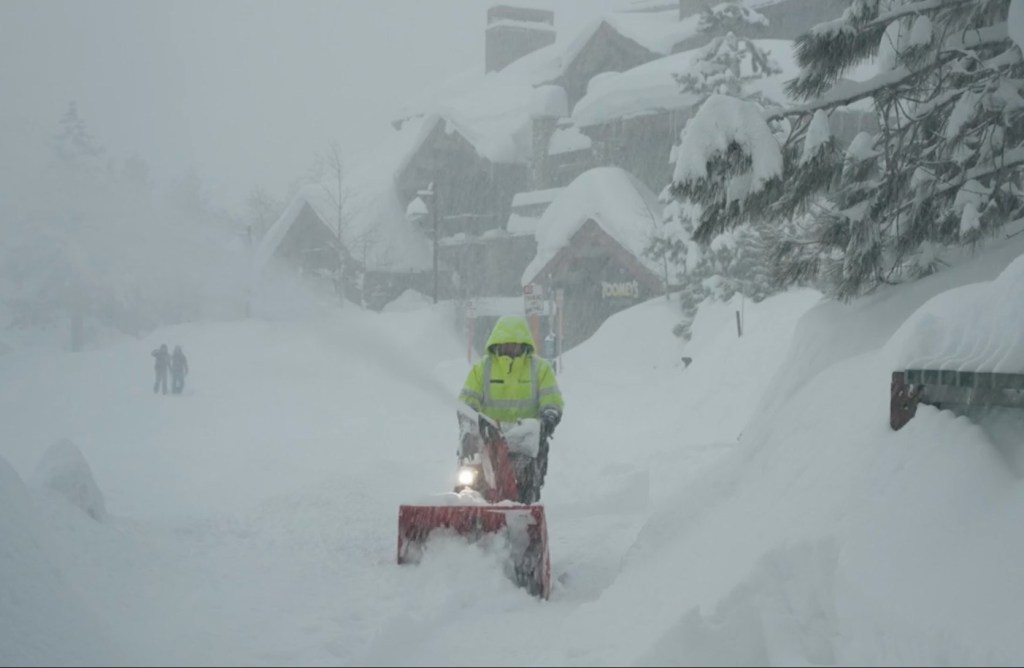
At California’s Mammoth Mountain main lodge, snow removal crews were dealing with three feet of fresh snow on Jan 10, which comes hot on the heels of the historic dumpings seen at the turn of the year.
Despite the blizzard-like conditions, Bill Benkwitt, who has been skiing these slopes for 50-years, was out.
“This is the most intense, longest-lasting snow I’ve ever seen,” said Benkwitt. “I mean it’s incredible, so God knows how much will be here by tomorrow.”
Tuesday morning’s additional three feet saw Mammoth pause its operations.
“We’ve been able to be open for the last few weeks but today we decided to close for the safety of our guests and employees,” Mammoth Mountain Communication Director Lauren Burke told CBS 8.
The amount of snow that has already fallen this year is staggering.
“Since we opened November 5th, we have received about 315 inches of snow, already surpassing last year’s numbers,” added Burke.
2010/11’s all-time record for snow (668.5 inches) is on course to be challenged.
“There’s a lot of big snowfall months ahead of us so this could be a record-breaking season. Definitely, a record-breaking 30 days, that’s for sure,” concluded Burke.
A worker uses a snowblower to carve out a path at Mammoth Mountain Resort on Jan 9, 2023.
Looking at California’s statewide snowpack, the best start to a season in 40-years is marching on.
As of Monday, the snow water equivalent increased to 199% of normal for the date, according to the California Department of Water Resources. However, ‘water experts’ are reluctant to signal too much optimism, because, I don’t know, ‘fear is sexy’?
“It’s great that we’ve been getting these storms, but we really can’t predict how long this will keep up,” Jeanine Jones, Interstate Resources Manager at DWR, told KTLA.
Jones added that the series of drenching storms might be too much of a good thing.
“We’re happy that we’re getting snowpack and we’re happy that we’re getting these storms. But we would like them to be suitably spaced out so we’re not having the flood risk,” she whined.
The forecast for the coming days and weeks is looking very snowy along the crucial Colorado River basins — Southern California’s primary source of drinking water.
Snow water equivalent in the Rockies is generally tracking similarly to that of Calis.
As it is in Utah, where state water experts there have said, “We’re about as wet as we can get.”
All of Utah’s basins are sitting at 150% of normal, with statewide snowpack climbing to 176%.
“It’s really positive,” said Jordan Clayton, supervisor of the Natural Resources Conservation Service’s Utah Snow Survey. “This is the fifth best start in our year for water supply in the period we’ve had records,” he added.
A partially buried speed limit sign in Millcreek Canyon, Tues, Jan. 3, 2023 [Kristin Murphy, Deseret News].
North America’s snow is helping push Total snow mass For the Northern Hemisphere’s further above the 1982-2012 average:
[FMI]
DECEMBER TEMPERATURE DATA IS IN
As we’re in the U.S., the official temperature data for December is in, courtesy of NOAA.
The final month of 2022 across the Lower 48 averaged-out at 33.28F, which is 1.06F below the multidecadal norm.
This continues December’s ‘non-trend’ even in propagandizing, UHI-ignoring datasets extending back to 1895:
Also, the year 2022 as a whole –again according to our friendly warm-mongering government agencies– finished with an average temperature of 53.40F. This puts it 18th in the list of warmest year on record and 0.12F above the multidecadal norm.
NOAA writes that 2022 ranks “in the warmest third of the record” — I guess ’18th’ wasn’t juicy enough for them.

It remains a mystery how the warmists have been convinced that Earth is heating in oblivion.
The power of propaganda, I suppose; the blind acceptance of trusting, compliant sacks of meat and bones.
Accept your experimental jab-jab-jab, the telescreens instructed, without questions; and while you’re at it, willingly accept a drastically lower living standard, and all, you know, for the sake of lineally and exponentially rising global temperatures:
Earth’s Average Temperature Dropped *AGAIN* In December, Now Down 0.66C From 2016 Peak
null
The sheep are walking us all over the cliff.
RELATED
Spring Chills Persist In South America; Russia Dips Below -30C (-24F); “Great Snow” Brought Record Winter Spending To New Zealand Resorts; + Australia Forecast Fierce November ColdOctober 24, 2022In “Extreme Weather”
China Suffers -50C (-58F) For First Time In 54 Years; The Russian Towns And Cities Enduring All-Time Record Cold; Kyrgyzstan’s Lake “That Never Freezes Over” Just Froze Over; + Arctic Blasts For Europe And North AmericaJanuary 20, 2023In “Articles”
Florida Drops Below Freezing–Tallahassee, And Others, Log Earliest Freezes On Record; -31.5C (-24.7F) In Canada; Feet Of Early-Season Snow Hit Northern India; + Climate FlimflamOctober 21, 2022In “Extreme Weather”

