__________________________________________________________________________________________________________
Blizzard warnings and winter storm warnings have been issued across the Midwest ahead of a fierce storm system that is forecast to intensify rapidly and produce howling winds and heavy snow.
AccuWeather meteorologists warn that time is running out to prepare for an expansive snowstorm that will unfold across parts of the nation’s midsection before the end of the week and jeopardize holiday travel plans ahead of Christmas.
The massive snowstorm was already affecting vast portions of the Plains and Rockies on Wednesday. As the storm strengthens into a powerful blizzard over the Midwest from Thursday to Friday, travel is likely to grind to a halt as dangerous and life-threatening conditions unfold from the storm’s high winds, snow and plunging temperatures.

The timing of this cross-country winter storm could not be worse, as millions rush to finish their shopping or embark on their holiday travels. During the period from Dec. 23 to Jan. 2, 112.7 million people are expected to travel more than 50 miles from home, according to the American Automobile Association (AAA).
The storm first brought wintry weather across the Northwest Monday night and Tuesday, with snow falling in cities like Seattle and Spokane, Washington. As it moves eastward, the storm will become progressively more potent.

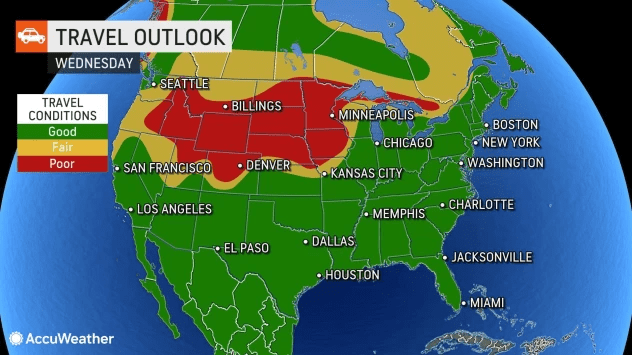
This map reflects the likelihood of weather-related delays on the roads for Wednesday only. The impact on flights is likely to be much more extensive. Highway delays will expand farther to the east and south through Friday.
Into Wednesday night, the worst of the travel delays will center on major hubs like Denver and Minneapolis. Ripple-effect delays from affected aircraft and crews will begin to expand across the nation, even in areas not directly impacted by the storm.
The strengthening storm will emerge from the Rockies Wednesday and Wednesday night. Snow will first begin across the Dakotas, Minnesota and Nebraska before it spreadssouthward. Accumulating snow could fall as far south as Colorado and Kansas before sunrise Thursday morning.

Ahead of the storm’s arrival, winter storm watches were issued across almost a dozen states in the Plains and Midwest on Tuesday. The watches were upgraded to winter storm warnings in Kansas City, St. Louis, Chicago , Detroit and Minneapolis on Wednesday. Blizzard warnings were issued for southern Minnesota, northern Iowa and the western portion of the Lower Peninsula of Michigan.
The snow will continue to expand from the central Plains into the Great Lakes and Ohio Valley into Thursday. Just north and west of the storm’s track, there is the potential for 6-12 inches of snow which AccuWeather meteorologists believe will stretch from northeastern Kansas into Michigan. Higher snow amounts, with the potential for an AccuWeather Local StormMax™ of 48,” are likely downwind of the Great Lakes.
Snow is expected to pile up rapidly on major highways including portions of interstates 55, 65, 70, 80, 90 and 94 can lead to slowed or stalled travel. Any areas left untreated, from highways to sidewalks, are likely to turn icy quickly.

The quick intensification of this storm across the center of the country during the week will bring noteworthy impacts, even outside of the snow. The storm will undergo a process called bombogenesis, which is when a storm (low pressure area) undergoes rapid strengthening and allows the barometric pressure of the storm to fall at least 0.71 of an inch (24 millibars) in 24 hours. Such storms are referred to as bomb cyclones in the weather community.
As the pressure plummets, winds will rush in and swirl at high speeds around the storm’s center.

“Strong winds are expected on the back side of the storm, bringing gusts in excess of 40 mph from the northern Plains all the way to the Texas Gulf Coast,” said AccuWeather Meteorologist Jake Sojda. Pockets of even stronger winds up to 70 or 80 mph are possible from northern Texas into the Great Lakes by week’s end,forecasters say.
The result of both snow and wind will be nothing short of blizzard conditions in many Midwestern states including Illinois, Indiana, Michigan, Ohio, Wisconsin, Iowa, Kansas, Nebraska and Missouri. A blizzard is officially defined by the National Weather Service as blowing and/or falling snow with winds of at least 35 mph that reduce the visibility to a quarter of a mile or less for at least three hours. The term has nothing to do with the depth or accumulation of snow from the storm.

There is a significant risk of motorists becoming stranded on the highways as conditions rapidly change during the storm. A sudden change in visibility is often a key factor in multi-vehicle pileups that can occur during winter weather. In other cases, snow could fall fast enough that cars or tracks could simply become stuck.AccuWeather meteorologists strongly urge motorists to complete their journey before the storm hits.
“Even after the worst of the precipitation and wind has ended, the storm’s impacts will linger across the region,” explained Sojda.
Frigid air, ongoing gusty winds, blowing and drifting snow and hard-packed snow and ice on the roads will continue to make for horrendous travel conditions on Christmas Eve and perhaps into Christmas Day across much of the Midwest.

High winds and temperatures plummeting into the 20s, teens and single digits Fahrenheit during the storm can result in life-threatening conditions for motorists who become stranded on highways in the Midwest. AccuWeather RealFeel® Temperatures during and after the storm in the snow zone will drop well below zero.
Locations to the south of the worst of the storm’s wintry precipitation should still brace for icy conditions and extreme cold, AccuWeather meteorologists warn.

“Precipitation in cites like Little Rock, Arkansas, Nashville and Atlanta is expected to start off as rain, but the sudden and extreme drop in temperature could still lead icy conditions,” explained Sojda.
AccuWeather’s team of more than 100 meteorologists will continue to provide updates on the storm and the outbreak of Arctic air through this week and into the Christmas weekend.

