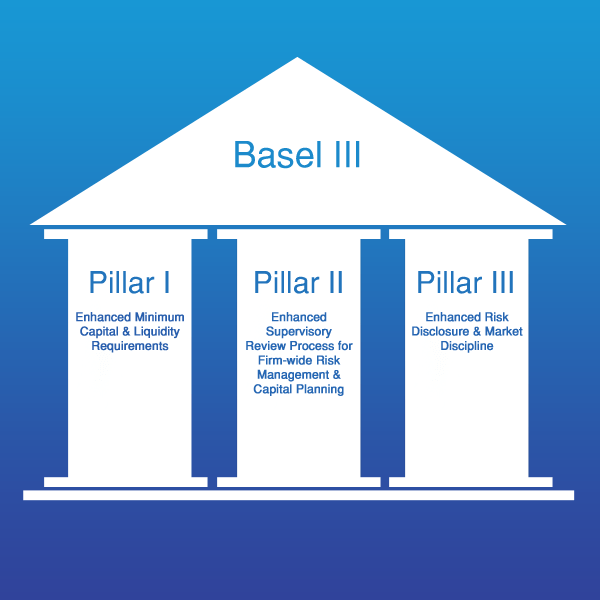
Understanding Basel III
Basel III, which is alternatively referred to as the Third Basel Accord or Basel Standards, is part of the continuing effort to enhance the international banking regulatory framework. It specifically builds on the Basel I and Basel II documents in a campaign to improve the banking sector’s ability to deal with financial stress, improve risk management, and promote transparency. On a more granular level, Basel III seeks to strengthen the resilience of individual banks in order to reduce the risk of system-wide shocks and prevent future economic meltdowns.
Key Principles of Basel III
1. Minimum Capital Requirements
The Basel III accord raised the minimum capital requirements for banks from 2% in Basel II to 4.5% of common equity, as a percentage of the bank’s risk-weighted assets. There is also an additional 2.5% buffer capital requirement that brings the total minimum requirement to 7%. Banks can use the buffer when faced with financial stress, but doing so can lead to even more financial constraints when paying dividends.
As of 2015, the Tier 1 capital requirement increased from 4% in Basel II to 6% in Basel III. The 6% includes 4.5% of Common Equity Tier 1 and an extra 1.5% of additional Tier 1 capital. The requirements were to be implemented starting in 2013, but the implementation date has been postponed several times, and banks now have until January 1, 2022, to implement the changes.
2. Leverage Ratio
Basel III introduced a non-risk-based leverage ratio to serve as a backstop to the risk-based capital requirements. Banks are required to hold a leverage ratio in excess of 3%. The non-risk-based leverage ratio is calculated by dividing Tier 1 capital by the average total consolidated assets of a bank.
To conform to the requirement, the Federal Reserve Bank of the United States fixed the leverage ratio at 5% for insured bank holding companies, and at 6% for Systematically Important Financial Institutions (SIFI).
3. Liquidity Requirements
Basel III introduced the usage of two liquidity ratios – the Liquidity Coverage Ratio and the Net Stable Funding Ratio. The Liquidity Coverage Ratio requires banks to hold sufficient highly liquid assets that can withstand a 30-day stressed funding scenario as specified by the supervisors. The Liquidity Coverage Ratio mandate was introduced in 2015 at only 60% of its stated requirements and is expected to increase by 10% each year till 2019 when it takes full effect.
On the other hand, the Net Stable Funding Ratio (NSFR) requires banks to maintain stable funding above the required amount of stable funding for a period of one year of extended stress. The NSFR was designed to address liquidity mismatches and will start becoming operational in 2018.
Impact of Basel III
The requirement that banks must maintain a minimum capital amount of 7% in reserve will make banks less profitable. Most banks will try to maintain a higher capital reserve to cushion themselves from financial distress, even as they lower the number of loans issued to borrowers. They will be required to hold more capital against assets, which will reduce the size of their balance sheets.
——————————————————————
All Debts are wiped.
Your money in the bank is safe and transfers to the new Precious Metal backed currency. This is why Europe has done Basel 3.
The Rainbow Treasury notes are ready in many countries. It may take some time for that unroll.
Gesara Funds will be rolled out too
Hence UBI.
Did everyone see Wells Fargo?
——————————————————————-
Research “COMEX 589 RULE” Mr Pool showed us this.
Research Bible Gold to Silver Ratio’s
1 : 15 from memory.
Do you the calculations now.
Silver & Copper are heavily underpriced. It has been the banks secret against us.
——————————————————————


Comex 589 will be to rocket Silver along with GOLD then
Basel 111 in June moving GOLD from a Tier 3 Asset to Tier 1 is obvious as it will be part of backing the Financial System.
GOLD WILL KILL THE FED, SILVER WILL BURY IT.

