Editor’s Note: Below is a l-o-n-g article teaching us of the historical evolution for that state of BEing often found in mediation, yet this state can also be recognized in the meditative state of doing routine chores. What is that highly prized state of BEing? That of the recognition of nothingness/silence/balance…
This the state some call Quantum Balance…the space between thoughts, the space between the particles of an atom where all is perfectly blended in silence. Whenever/however this point is reached, a great calm of Self appears holding the vibration of absolute Knowing/stillness/completion/satisfaction/bliss where All things are good…very good.
So…how is this state reached and how long does this last? Again…I recommend meditation (watching your thoughts) until the thoughts slow and stop, or immerse yourself in a rouinte task that is mindless and become ‘headless’ (non-thinking). The moment where thoughts stop may be momentary or last a bit longer, yet the realizations from this moment will affect your entire self and change your perspective of the world.
Seek this state, understand the Vibration of your Magnificence, BE your Quantum Love, and then BE in…
Quantum Joy!
___________________________________________________________________________________________
The Heart Sūtra (Sanskrit: प्रज्ञापारमिताहृदय Prajñāpāramitāhṛdaya or Chinese: 心經 Xīnjīng) is a popular sutra in Mahāyāna Buddhism. Its Sanskrit title, Prajñāpāramitāhṛdaya, can be translated as “The Heart of the Perfection of Wisdom”.
The sutra famously states, “Form is empty, emptiness is form.” (śūnyatā). It is a condensed exposé on the Buddhist Mahayana teaching of the Two Truths doctrine, which says that ultimately all phenomena are sunyata, empty of an unchanging essence. This emptiness is a ‘characteristic’ of all phenomena, and not a transcendent reality, but also “empty” of an essence of its own. Specifically, it is a response to Sarvastivada teachings that “phenomena” or its constituents are real.[2]:9
It has been called “the most frequently used and recited text in the entire Mahayana Buddhist tradition.”
Summary of the sutra
In the sutra, Avalokiteśvara addresses Śariputra, explaining the fundamental emptiness (śūnyatā) of all phenomena, known through and as the five aggregates of human existence (skandhas): form (rūpa), feeling (vedanā), volitions (saṅkhāra), perceptions (saṃjñā), and consciousness (vijñāna). Avalokiteśvara famously states, “Form is Emptiness (śūnyatā). Emptiness is Form”, and declares the other skandhas to be equally empty—that is, dependently originated.
Avalokiteśvara then goes through some of the most fundamental Buddhist teachings such as the Four Noble Truths, and explains that in emptiness none of these notions apply. This is interpreted according to the two truths doctrine as saying that teachings, while accurate descriptions of conventional truth, are mere statements about reality—they are not reality itself—and that they are therefore not applicable to the ultimate truth that is by definition beyond mental understanding. Thus the bodhisattva, as the archetypal Mahayana Buddhist, relies on the perfection of wisdom, defined in the Mahāprajñāpāramitā Sūtra to be the wisdom that perceives reality directly without conceptual attachment thereby achieving nirvana.
The sutra concludes with the mantra gate gate pāragate pārasaṃgate bodhi svāhā, meaning “gone, gone, everyone gone to the other shore, awakening, svaha.”[note 1]
Popularity and stature
The Heart Sutra is “the single most commonly recited, copied and studied scripture in East Asian Buddhism.”[4][2][note 2] [note 3] It is recited by adherents of Mahayana schools of Buddhism regardless of sectarian affiliation.[5]:59–60
While the origin of the sutra is disputed by some modern scholars,[6] it was widely known in Bengal and Bihar during the Pala Empire period (c. 750–1200 CE) in India, where it played a role in Vajrayana Buddhism.[7]:239,18–20[note 4] The stature of the Heart Sutra throughout early medieval India can be seen from its title ‘Holy Mother of all Buddhas Heart of the Perfection of Wisdom’[8]:389 dating from at least the 8th century CE (see Philological explanation of the text).[2]:15–16[7]:141,142[note 5]
The long version of the Heart Sutra is extensively studied by the various Tibetan Buddhist schools, where the Heart Sutra is chanted, but also treated as a tantric text, with a tantric ceremony associated with it.[7]:216–238 It is also viewed as one of the daughter sutras of the Prajnaparamita genre in the Vajrayana tradition as passed down from Tibet.[9]:67–69[10]:2[note 6][note 7]
The text has been translated into many languages, and dozens of English translations and commentaries have been published, along with an unknown number of informal versions on the internet.
source: en.wikipedia.org/wiki/Heart_Sutra
Bodhisattva Avalokitesvara: Guanyin
“There is no place where he will not manifest himself.
The suffering of those in the troubled states of being:
Hell-dwellers, hungry ghosts, and animals;
And the suffering of birth, old age, illness, and death
Will gradually be extinguished.
— The Lotus Sutra, trans. Tsugunari Kubo and Akira Yuyama, Bukkyō Dendō Kyōkai 2007. 301.
It is generally agreed among Chinese Buddhists and scholars of Buddhist studies that the figure Guanyin is the Bodhisattva Avalokitesvara.
As a reminder from last week, Avalokitesvara is the bodhisattva who represents compassion. The Lotus Sutra, one of the most important texts in Mahayana Buddhism, describes Avalokitesvara extensively in Chapter 25. Avalokitesvara is also an interlocutor in the Heart Sutra, the short but influential sutra on the perfection of wisdom.
Guanyin in Chinese means “Perceiver of all Sounds,” which refers to the way in which Guanyin is able to hear all prayers and cries for help.

In India, bodhisattvas are genderless or are referred to as male. The Bodhisattva Avalokitesvara, or Guanyin, is often depicted as female in China.
One reason for this gender fluidity is due to the way the Bodhisattva has the ability to manifest on earth in many different forms.
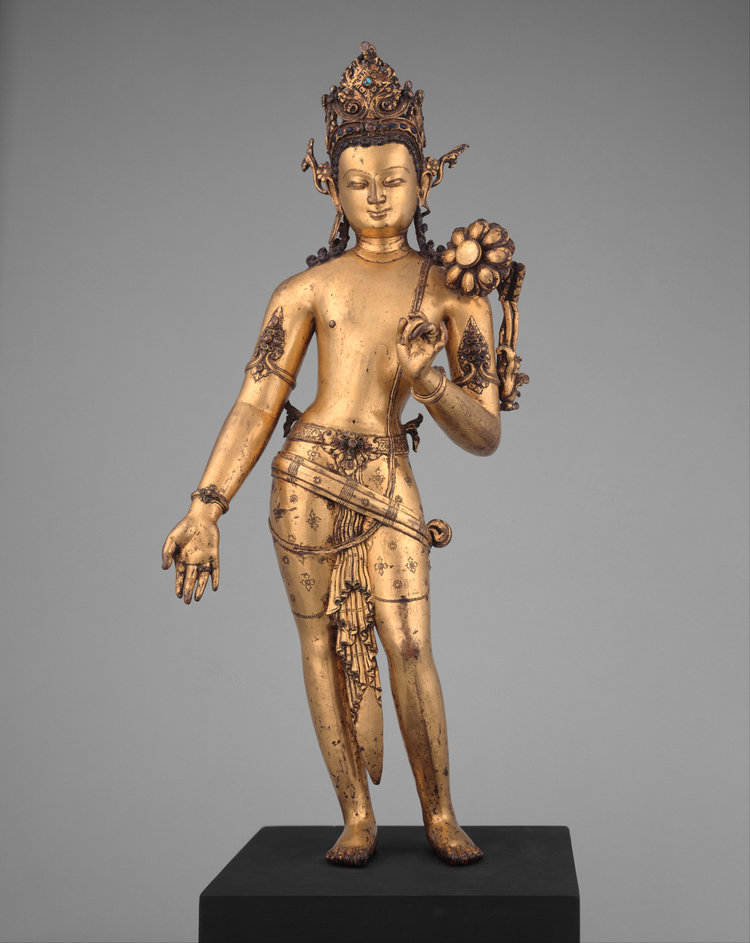
One of Avalokitesvara’s many forms is Padmapani Lokesvara, which means “Lord with a Lotus in his Hand.”
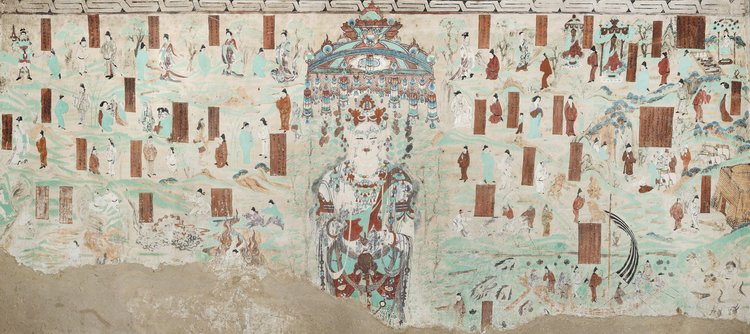
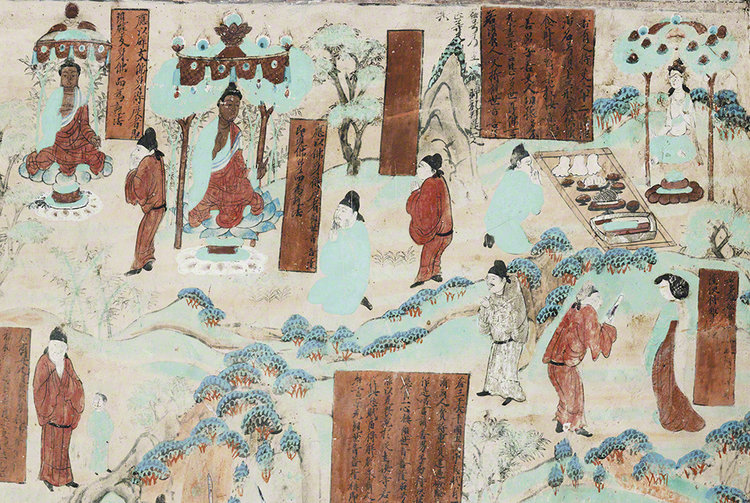
Below is a detail from the Guanyin mural in Mogao Cave 45 at Dunhuang.
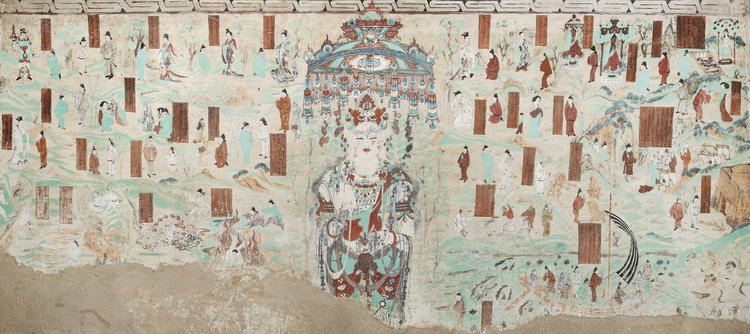
The larger image (found at the beginning of this post) depicts Chapter 25 of the Lotus Sutra, which describes the way in which Avalokitesvara appears to all who need help, in whatever form.
The detail below represents several different scenes in which a human being is in a supplicatory posture facing another figure. That other figure is Avalokitesvara manifesting on earth as either male or female, deity or human.
If you order any product on Amazon through the following links the proceeds will go towards our Ecuador healing retreat center.
Another reason for the tendency towards a feminine representation of Avalokitesvara in China has to do with the fact that the Chinese often prayed to Guanyin for children, especially sons.
This sometimes worked, and statues of Guanyin in certain temples would become known for their ability to bestow sons.
The ivory statue below represents Guanyin as the “Bestower of Sons.”
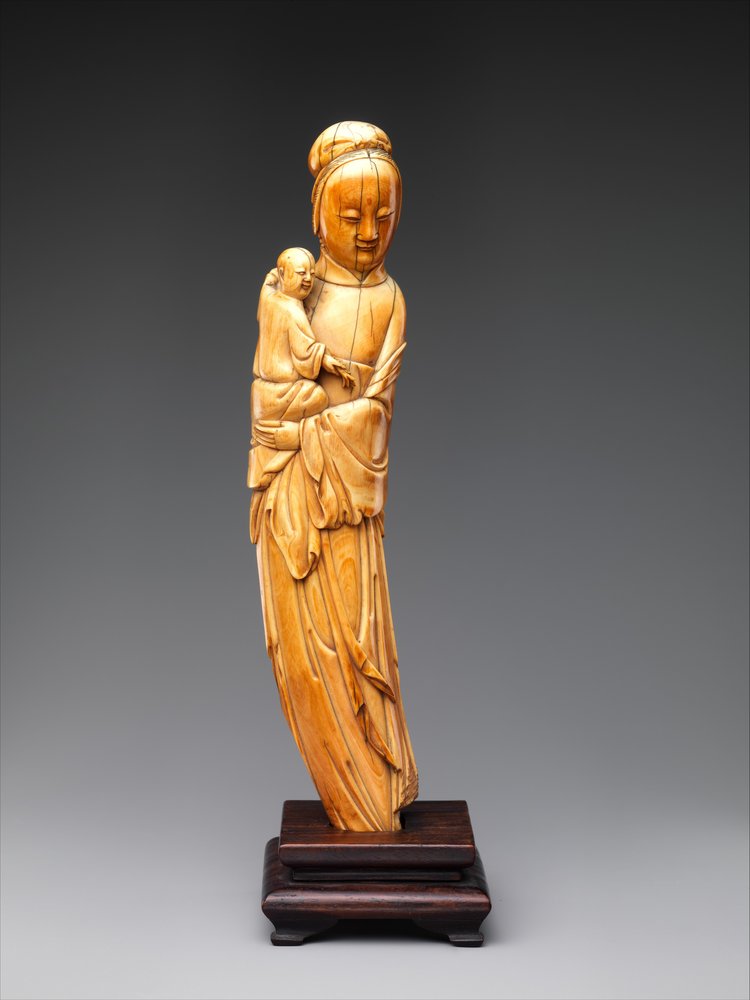
Below is another depiction of Guanyin bestowing a son.
Besides Guanyin, another important figure featured in this lavish Ming painting is Sudhana, the young boy at the feet of the majestic lion.
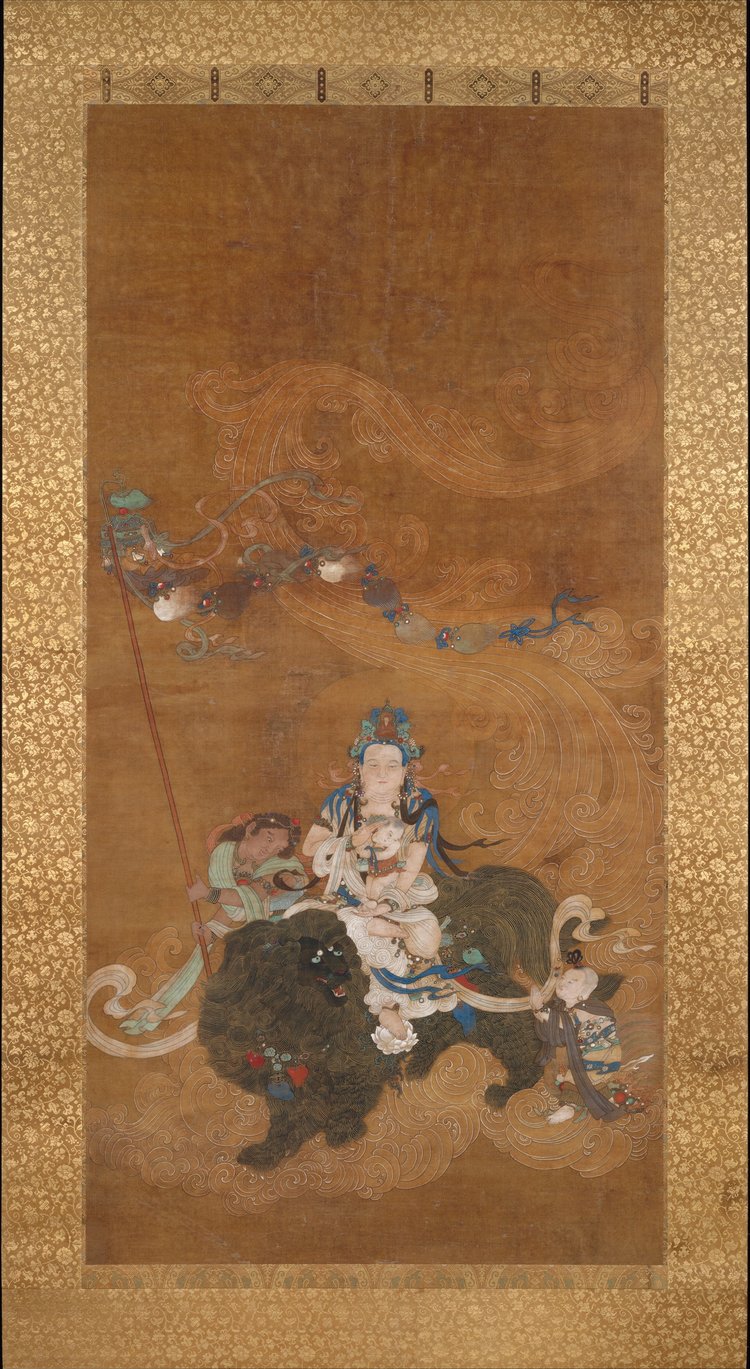
In the Gandavyuha Sutra, Sudhana is the protagonist who journeys to Mount Potalaka seek advice on enlightenment from Avalokitesvara.
The sutra describes the mythical home of Avalokitesvara as an isolated mountain rising out of the seas.
“The precise location of the mountain is the subject of considerable speculation. According to Xuanzhang, it is located in southern India to the east of the Malaya Mountains. He describes it as a perilous mountain with a lake and a heavenly stone palace at the summit. A river flows from the summit, encircling the mountain twenty times before flowing into the South Sea. Those who seek to meet the bodhisattva scale the mountain, but few succeed.”
~ The Princeton Dictionary of Buddhism. Edited by Donald S. Lopez Jr. and Robert E. Buswell Jr.
The Chinese interpretation of Potalaka is Mount Putuo, which Chinese Buddhists believe to be in Zhejiang Province.
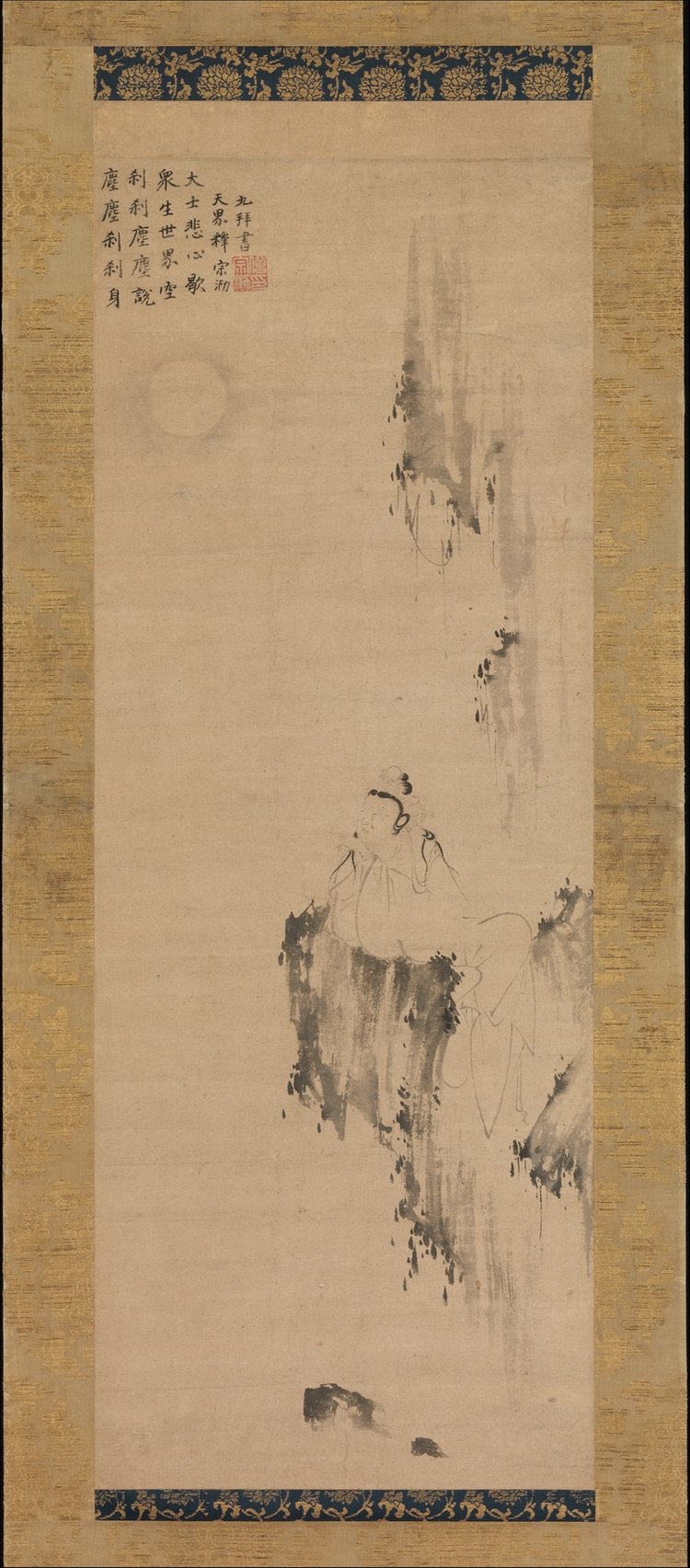
Another popular form of Guanyin is the White-Robed Guanyin, the form in which Avalokitesvara wears a clean, white robe in the tranquil, otherworldly setting of Mount Putuo.
The artist of this painting is unknown, but the poem at the top was stamped by Ming official Quan Shi Zong Le. From right to left, the poem reads:
“Like a speck of dust, ephemeral is the body,
So is the doctrine ephemeral, like a speck of dust.
Only when all sentient beings and the world attain emptiness
Will [Guanyin]’s all-compassionate heart rest.
— Wen Fong, Beyond Representation: Chinese Paintings and Calligraphy, 8th-14th Century. Page 362.
FURTHER READING
- Buddha Weekly: Guan Yin and the ten great protections of the Goddess of Mercy
- Indira Gandhi National Centre for the Arts: The Creation of the Goddess of Mercy from Avalokitesvara
- The Met: White Robed Guanyin
- Oxford Research Encyclopedias: Avalokitesvara, the Bodhisattva of Compassion
- Plum Village: The Heart Sutra translated by Thich Nhat Hanh
The Lotus Sutra. Translated by Tsugunari Kubo and Akira Yuyama. Berkeley: Bukkyō Dendō Kyōka Numata (2007).
Buswell, Robert E., Donald S. Lopez. The Princeton Dictionary of Buddhism. Princeton: Princeton University (2004).
Fong, Wen. Beyond Representation: Chinese Paintings and Calligraphy, 8th-14th Century. New York: The Metropolitan Museum of Art (1992).
source: dunhuangfoundation.us/blog/2017/10/18/bodhisattva-avalokitesvara-guanyin
If you order any product on Amazon through the following links the proceeds will go towards the Ecuador healing retreat center.
Heart Sutra
In 1999, Michael Rothenberg became the caretaker for his teacher and mentor, Philip Whalen. The following poem is taken from his recent book, written as a eulogy to the late poet.
Dharma transmission:
“another maniac unleashed, alas!”
Buddhism in America
“The upper middle way”
Old Hippie
say someone gives you roses
and you’re allergic to roses
can you still be romantic about roses?
Generosity, Humanity, Heart What is the Heart Sutra?
it’s the body being passed overhead
above a crowd
of politicians and power-mad bureaucrats
by the keepers of the faith
*
Oceanly Cosmos
Buddhist Disco
What is Sangha?
Ecology of Permission
Poolside, Bedside
All sides inside & out
Dharma, Karma
Parmagian cheese
Oh, Rome,
the hospital is closing
& patients in the extended
nursing
wing are listening to the visiting
keyboardist play
“Old Man River”
*
talisman
Heart Sutra
huge mass of Buddhist philosophy
condensed into a few lines
reduced to a mantra:
“Gone, Gone
Gone beyond
Gone beyond beyond
Hail . . .”
From Unhurried Vision, © 2003 by Michael Rothenberg. Reprinted with permission of La Alameda Press.
- Perhaps because of both its profundity and its brevity, the Heart Sutra is the most familiar of all the original teachings of the Buddha. (The Sino-Japanese version comprises a mere 262 characters.) Recited daily by Buddhists in China, Korea, Vietnam, Japan, Tibet, Mongolia, Bhutan, Nepal, the Heart Sutra is now also recited by many Buddhists in North America. The Sino-Japanese and monosyllabic Korean versions lend themselves well to chanting, and there are now several English translations. The basic text of the Zen tradition, it must also be the only sutra to be found (in Japan) printed on a man’s tie.

According to Buddhist lore, the Heart Sutra was first preached on Vulture Peak, which lies near the ancient Indian city of Rajagraha, and is said to have been the Buddha’s favorite site.
In this sutra, the Buddha inspires one of his closest disciples, Sariputra, to request Avalokitesvara, the Bodhisattva of compassion, to instruct him in the practice of prajnaparamita, the perfection of wisdom. Avalokitesvara’s response contains one of the most celebrated of all Buddhist paradoxes—”form is emptiness; emptiness is form.” And the sutra ends with one of the most popular Buddhist mantras—gate gate paragate parasamgate bodhi svaha: gone, gone, gone beyond, gone completely beyond…(When chanted, gate has two short vowels with the accent on the first syllable.)
The tradition of composing commentary on the Heart Sutra goes back to at least the eighth century, and includes many of the great Buddhist philosophers and meditation masters. What follows here are versions of the sutra and excerpts from some contemporary commentaries addressed to Westerners.
English translations of Buddhist language are not standardized. Variations of, for example, “Avalokitesvara” or “sunyata” or “sutra” reflect differences between Pali and Sanskrit, as well as the national origins of the translators.—Ed.
THE GREAT PRAJNA PARAMITA HEART SUTRA
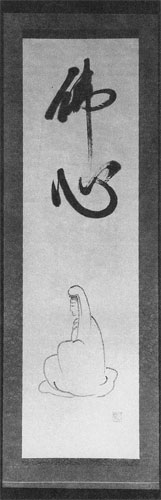
Avalokitesvara Bodhisattva doing deep Prajna Paramita
Perceived the emptiness of all five conditions, and was freed of pain.
O Sariputra, form is no other than emptiness, emptiness no other than form;
Form is precisely emptiness, emptiness precisely form;
Sensation, perception, reaction and consciousness are also like this.
O Sariputra, all things are expressions of emptiness, not born, not destroyed,
Not stained, not pure; neither waxing nor waning.
Thus emptiness is not form; not sensation nor perception, reaction nor consciousness;
No eye, ear, nose, tongue, body, mind;
No color, sound, smell, taste, touch, thing
No realm of sight, no realm of consciousness
No ignorance, no end to ignorance
No old age and death, no cessation of old age and death
No suffering, no cause or end to suffering, no path
No wisdom and no gain. No gain—thus
Bodhisattvas live this Prajna Paramita
With no hindrance of mind—no hindrance therefore no fear
Far beyond all such delusion, Nirvana is already here.
All past, present, and future Buddhas live this Prajna Paramita
And attain supreme, perfect enlightenment.
Therefore know that Prajna Paramita is
The holy mantra, the luminous mantra
The supreme mantra, the incomparable mantra
By which all suffering is cleared. This is no other than truth.
Therefore set forth the Prajna Paramita mantra,
Set forth this mantra and proclaim:
Gate Gate Paragate Parasamgate Bodhi Svaha!
– From the sutra book used by The Zen Community of New York.
Commentary by Thich Nhat Hanh
Perfect understanding is prajnaparamita. The word “wisdom” is usually used to translate prajna, but I think that wisdom is somehow not able to convey the meaning. Understanding is like water flowing in a stream. Wisdom and knowledge are solid and can block our understanding. In Buddhism, knowledge is regarded as an obstacle for understanding. If we take something to be the truth, we may cling to it so much that even if the truth comes and knocks at our door, we won’t want to let it in. We have to be able to transcend our previous knowledge the way we climb up a ladder. If we are on the fifth rung and think that we are very high, there is no hope for us to step up to the sixth. We must learn to transcend our own views. Understanding, like water, can flow, can penetrate. Views, knowledge, and even wisdom are solid, and can block the way of understanding.
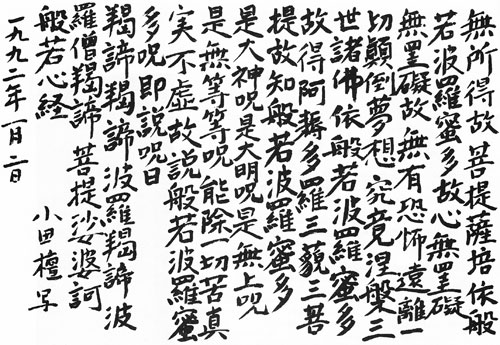
Heart Sutra in Japanese done for Tricycle on January 2, 1992 by Mayumi Oda. Text by Vietnamese Zen Master Thich Nhat Hanh, from The Heart of Understanding, reprinted with permission from Parallax Press.
Avalokita found the five skandhas empty. But, empty of what? The key word is empty. To be empty is to be empty of something.
If I am holding a cup of water and I ask you, “Is this cup empty?” you will say, “No, it is full of water.” But if I pour out the water and ask you again, you may say, “Yes, it is empty.” But, empty of what? Empty means empty of something. The cup cannot be empty of nothing. “Empty” doesn’t mean anything unless you know empty of what. My cup is empty of water, but it is not empty of air. To be empty is to be empty of something. This is quite a discovery. When Avalokita says that the five skandhas are equally empty, to help him be precise we must ask, “Mr. Avalokita, empty of what?”
The five skandhas, which may be translated into English as five heaps, or five aggregates, are the five elements that comprise a human being. These five elements flow like a river in every one of us. In fact, these are really five rivers flowing together in us: the river of form, which means our body, the river of feelings, the river of perceptions, the river of mental formations, and the river of consciousness. They are always flowing in us. So according to Avalokita, when he looked deeply into the nature of these five rivers, he suddenly saw that all five are empty. And if we ask, “Empty of what?” he has to answer. And this is what he said: “They are empty of a separate self.” That means none of these five rivers can exist by itself alone. Each of the five rivers has to be made by the other four. They have to co-exist; they have to inter-be with all the others.
Avalokita looked deeply into the five skandhas of form, feelings, perceptions, mental formations, and consciousness, and he discovered that none of them can be by itself alone. Each can only inter-be with all the others. So he tells us that form is empty. Form is empty of a separate self, but it is full
of everything in the cosmos. The same is true with feelings, perceptions, mental formations, and consciousness.
Perhaps because of both its profundity and its brevity, the Heart Sutra is the most familiar of all the original teachings of the Buddha. (The Sino-Japanese version comprises a mere 262 characters.) Recited daily by Buddhists in China, Korea, Vietnam, Japan, Tibet, Mongolia, Bhutan, Nepal, the Heart Sutra is now also recited by many Buddhists in North America. The Sino-Japanese and monosyllabic Korean versions lend themselves well to chanting, and there are now several English translations. The basic text of the Zen tradition, it must also be the only sutra to be found (in Japan) printed on a man’s tie.
According to Buddhist lore, the Heart Sutra was first preached on Vulture Peak, which lies near the ancient Indian city of Rajagraha, and is said to have been the Buddha’s favorite site.
In this sutra, the Buddha inspires one of his closest disciples, Sariputra, to request Avalokitesvara, the Bodhisattva of compassion, to instruct him in the practice of prajnaparamita, the perfection of wisdom. Avalokitesvara’s response contains one of the most celebrated of all Buddhist paradoxes—”form is emptiness; emptiness is form.” And the sutra ends with one of the most popular Buddhist mantras—gate gate paragate parasamgate bodhi svaha: gone, gone, gone beyond, gone completely beyond…(When chanted, gate has two short vowels with the accent on the first syllable.)
The tradition of composing commentary on the Heart Sutra goes back to at least the eighth century, and includes many of the great Buddhist philosophers and meditation masters. What follows here are versions of the sutra and excerpts from some contemporary commentaries addressed to Westerners.
English translations of Buddhist language are not standardized. Variations of, for example, “Avalokitesvara” or “sunyata” or “sutra” reflect differences between Pali and Sanskrit, as well as the national origins of the translators.—Ed.
THE SUTRA OF THE HEART OF TRANSCENDENT KNOWLEDGE
Thus have I heard. Once the Blessed One was dwelling in Rajagriha at Vulture Peak mountain, together with a great gathering of the sangha of monks and a great gathering of the sangha of bodhisattvas. At that time the Blessed One entered the samadhi that expresses the dharma called “profound illumination,” and at the same time noble Avalokiteshvara, the bodhisattva mahasattva, while practicing the profound prajnaparamita, saw in this way: he saw the five skandhas to be empty of nature.
Then, through the power of the Buddha, venerable Shariputra said to noble Avalokiteshvara, the bodhisattva mahasattva, “How should a son or daughter of noble family train, who wishes to practice the profound prajnaparamita?”
Addressed in this way, noble Avalokiteshvara, the bodhisattva mahasattva, said to venerable Shariputra, “O Shariputra, a son or daughter of noble family who wishes to practice the profound prajnaparamita should see in this way: seeing the five skandhas to be empty of nature. Form is emptiness; emptiness also is form. Emptiness is no other than form; form is no other than emptiness. In the same way, feeling, perception, formation, and consciousness are emptiness. Thus, Shariputra, all dharmas are emptiness. There are no characteristics. There is no birth and no cessation. There is no impurity and no purity. There is no decrease and no increase. Therefore, Shariputra, in emptiness, there is no form, no feeling, no perception, no formation, no consciousness; no eye, no ear, no nose, no tongue, no body, no mind; no appearance, no sound, no smell, no taste, no touch, no dharmas; no eye dhatu up to no mind dhatu, no dhatu of dharmas, no mind consciousness dhatu; no ignorance, no end of ignorance up to no old age and death, no end of old age and death; no suffering, no origin of suffering, no cessation of suffering, no path, no wisdom, no attainment, and no nonattainment. Therefore, Shariputra, since the bodhisattvas have no attainment, they abide by means of prajnaparamita. Since there is no obscuration of mind, there is no fear. They transcend falsity and attain complete nirvana. All the buddhas of the three times, by means of prajnaparamita, fully awaken to unsurpassable, true, complete enlightenment. Therefore, the great mantra of prajnaparamita, the mantra of great insight, the unsurpassed mantra, the unequaled mantra, the mantra that calms all suffering, should be known as truth, since there is no deception. The prajnaparamita mantra is said in this way:
OM GATE GATE PARA GATE PARASAMGATE BODHI SVAHA
Thus, Shariputra, the bodhisattva mahasattva should train in the profound prajnaparamita.” Then the Blessed One arose from that samadhi and praised noble Avalokiteshvara, the bodhisattva mahasattva, saying, “Good, good, O son of noble family; thus it is, O son of noble family, thus it is. One should practice the profound prajnaparamita just as you have taught and all the tathagatas will rejoice.” When the Blessed One had said this, venerable Shariputra and noble Avalokiteshvara, the bodhisattva mahasattva, that whole assembly and the world with its gods, humans, asuras, and gandharvas rejoiced and praised the words of the Blessed One.
The Nalanda Translation Committee, under the direction of Chogyam Trungpa Rinpoche, translated this version of the Heart Sutra from Tibetan. Reprinted with the permission of the Nalanda Translation Committee, Halifax, N.S. Copywrite 1978 Chogyam Trungpa.
Perhaps because of both its profundity and its brevity, the Heart Sutra is the most familiar of all the original teachings of the Buddha. (The Sino-Japanese version comprises a mere 262 characters.) Recited daily by Buddhists in China, Korea, Vietnam, Japan, Tibet, Mongolia, Bhutan, Nepal, the Heart Sutra is now also recited by many Buddhists in North America. The Sino-Japanese and monosyllabic Korean versions lend themselves well to chanting, and there are now several English translations. The basic text of the Zen tradition, it must also be the only sutra to be found (in Japan) printed on a man’s tie.
According to Buddhist lore, the Heart Sutra was first preached on Vulture Peak, which lies near the ancient Indian city of Rajagraha, and is said to have been the Buddha’s favorite site.
In this sutra, the Buddha inspires one of his closest disciples, Sariputra, to request Avalokitesvara, the Bodhisattva of compassion, to instruct him in the practice of prajnaparamita, the perfection of wisdom. Avalokitesvara’s response contains one of the most celebrated of all Buddhist paradoxes—”form is emptiness; emptiness is form.” And the sutra ends with one of the most popular Buddhist mantras—gate gate paragate parasamgate bodhi svaha: gone, gone, gone beyond, gone completely beyond…(When chanted, gate has two short vowels with the accent on the first syllable.)
The tradition of composing commentary on the Heart Sutra goes back to at least the eighth century, and includes many of the great Buddhist philosophers and meditation masters. What follows here are versions of the sutra and excerpts from some contemporary commentaries addressed to Westerners.
English translations of Buddhist language are not standardized. Variations of, for example, “Avalokitesvara” or “sunyata” or “sutra” reflect differences between Pali and Sanskrit, as well as the national origins of the translators.—Ed.
Commentary by Chogyam Trungpa Rinpoche
Cutting through our conceptualized versions of the world with the sword of prajna, we discover shunyata—nothingness, emptiness, voidness, the absence of duality and conceptualization. The best known of the Buddha’s teachings on this subject are presented in the Prajnaparamita-hridaya, also called the Heart Sutra; but interestingly in this sutra the Buddha hardly speaks a word at all. At the end of the discourse he merely says, “Well said, well said,” and smiles. He created a situation in which the teaching of shunyata was set forth by others, rather than himself being the actual spokesman. He did not impose his communication but created the situation in which teaching could occur, in which his disciples were inspired to discover and experience shunyata. There are twelve styles of presenting the dharma and this is one of them.
This sutra tells of Avalokiteshvara, the bodhisattva who represents compassion and skillful means, and Shariputra, the great arhat who represents prajna, knowledge. There are certain differences between the Tibetan and Japanese translations and the Sanskrit original, but all versions make the point that Avalokiteshvara was compelled to awaken to shunyata by the overwhelming force of prajna. Then Avalokiteshvara spoke with Shariputra, who represents the scientific-minded person or precise knowledge. The teachings of the Buddha were put under Shariputra’s microscope, which is to say that these teachings were not accepted on blind faith but were examined, practiced, tried and proved.
Avalokiteshvara said: “Oh Shariputra, form is emptiness, emptiness is form; form is no other than emptiness, emptiness is no other than form.” We need not go into the details of their discourse, but we can examine this statement about form and emptiness, which is the main point of the sutra. And so we should be very clear and precise about the meaning of the term “form.”
Form is that which is before we project our concepts onto it. It is the original state of “what is here,” the colorful, vivid, impressive, dramatic, aesthetic qualities that exist in every situation. Form could be a maple leaf falling from a tree and landing on a mountain river; it could be full moonlight, a gutter in the street or a garbage pile. These things are “what is,” and they are all in one sense the same: they are all forms, they are all objects, they are just what is. Evaluations regarding them are only created later in our minds. If we really look at these things as they are, they are just forms.
So form is empty. But empty of what? Form is empty of our preconceptions, empty of our judgments. If we do not evaluate and categorize the maple leaf falling and landing on the stream as opposed to the garbage heap in New York, then they are there, what is. They are empty of preconception. They are precisely what they are, of course! Garbage is garbage, a maple leaf is a maple leaf, “what is” is “what is.” Form is empty if we see it in the absence of our own personal interpretations of it.
But emptiness is also form. That is a very outrageous remark. We thought we had managed to sort everything out, we thought we had managed to see that everything is the “same” if we take out our preconceptions. That made a beautiful picture: everything bad and everything good that we see are both good. Fine. Very smooth. But the next point is that emptiness is also form, so we have to re-examine. The emptiness of the maple leaf is also form; it is not really empty. The emptiness of the garbage heap is also form. To try to see these things as empty is also to clothe them in concept. Form comes back. It was too easy, taking away all concept, to conclude that everything simply is what is. That could be an escape, another way of comforting ourselves. We have to actually feel things as they are, the qualities of the garbage heapness and the qualities of the maple leafness, the isness of things. We have to feel them properly, not just trying to put a veil of emptiness over them. That does not help at all. We have to see the “isness” of what is there, the raw and rugged qualities of things precisely as they are. This is a very accurate way of seeing the world. So first we wipe away all our heavy preconceptions, and then we even wipe away the subtleties of such words as “empty,” leaving us nowhere, completely with what is.
Finally we come to the conclusion that form is just form and emptiness is just emptiness, which has been described in the sutra as seeing that form is no other than emptiness, emptiness is no other than form; they are indivisible. We see that looking for beauty or philosophical meaning to life is merely a way of justifying ourselves, saying that things are not so bad as we think. Things are as bad as we think! Form is form, emptiness is emptiness, things are just what they are and we do not have to try to see them in the light of some sort of profundity. Finally we come down to earth, we see things as they are. This does not mean having an inspired mystical vision with archangels, cherubs and sweet music playing. But things are seen as they are, in their own qualities. So shunyata in this case is the complete absence of concepts or filters of any kind, the absence even of the “form is empty” and the “emptiness is form.”
Excerpted from Cutting Through Spiritual Materialism and reprinted with permission from Shambhala Publications, Inc.
Commentary by Shunryu Suzuki Roshi
In the Prajna Paramita Sutra the most important point, of course, is the idea of emptiness. Before we understand the idea of emptiness, everything seems to exist substantially. But after we realize the emptiness of things, everything becomes real—not substantial. When we realize that everything we see is a part of emptiness, we can have no attachment to any existence; we realize that everything is just a tentative form and color. Thus we realize the true meaning of each tentative existence. When we first hear that everything is a tentative existence, most of us are disappointed; but this disappointment comes from a wrong view of man and nature. It is because our way of observing things is deeply rooted in our self-centered ideas that we are disappointed when we find everything has only a tentative existence. But when we actually realize this truth, we will have no suffering. Calligraphy by Jakusho Kwong.This sutra says, “Bodhisattva Avalokitesvara observes that everything is emptiness, thus he forsakes all suffering.” It was not after he realized this truth that he overcame suffering—to realize this fact is itself to be relieved from suffering. So realization of the truth is salvation itself. We say, “to realize,” but the realization of the truth is always near at hand. It is not after we practice zazen that we realize the truth; even before we practice zazen, realization is there. It is not after we understand the truth that we attain enlightenment. To realize the truth is to live—to exist here and now. So it is not a matter of understanding or of practice. It is an ultimate fact. In this sutra Buddha is referring to the ultimate fact that we always face moment after moment. This point is very important. This is Bodhidharma’s zazen. Even before we practice it, enlightenment is there. But usually we understand the practice of zazen and enlightenment as two different things: here is practice, like a pair of glasses, and when we use the practice, like putting the glasses on, we see enlightenment. This is the wrong understanding. The glasses themselves are enlightenment, and to put them on is also enlightenment. So whatever you do, or even though you do not do anything, enlightenment is there, always. This is Bodhidharma’s understanding of enlightenment.Excerpted from Zen Mind, Beginner’s Mind and reprinted with permission from Weatherhill Press.THREE COMMENTARIES ON THE GREAT MANTRA
Set forth this mantra and proclaim:
Gate Gate Paragate Parasamgate Bodhi Svaha!
Mu Soeng Sunim
Gate gatemeans gone, gone; paragate means gone over; parasamgate means gone beyond (to the other shore of suffering or the bondage of samsara); bodhi means the Awakened Mind; svaha is the Sanskrit word for homage or proclamation. So, the mantra means “Homage to the Awakened Mind which has gone over to the other shore (of suffering).”
Whatever perspective one may take on the inclusion of the mantra at the end of the sutra, it does not put a blemish on what the sutra has tried to convey earlier: the richness of intuitive wisdom coming out of the pure experience of complete stillness, of complete cessation, away from all concepts and categories.
Zen masters, in echoing the theme of emptiness, like to agree with existentialist thinkers that “life” has no meaning or reason. The Heart Sutra uses the methodology of negation as a way of pointing to this lack of any inherent meaning or reason in the phenomenal world, including the world of the mind. It takes each of the existents, holds it up under an unflinching gaze and declares it to have no sustaining self-nature. This is the wisdom teaching of sunyata of the Mahayana tradition. But, at the same time, compassion is the other and equally important teaching of Mahayana. How do we then bridge the gap between sunyata as ultimate reality and the conventionality of human existance? The existentialist thinkers agonized over this problem and were led to despair and anarchy. In Mahayana, compassion, which is a natural, unenforced by-product of a deep state of meditation, supports the wisdom of emptiness, yet allows the individual to have empathy with the conventional appearance of the world without getting lost in it. It may be that compassion works best as a post-enlightenment existential crisis, but nonetheless without compassion as a guiding paradigm, the unrelenting precision of sunyata can make life bearable.
Excerpted from Heart Sutra: Ancient Wisdom in the Light of Quantum Reality and reprinted with permission from Primary Point Press.
Trungpa Rinpoche
The Heart Sutraends with “the great spell” or mantra. It says in the Tibetan version: “Therefore the mantra of transcendent knowledge, the mantra of deep insight, the unsurpassed mantra, the unequalled mantra, the mantra which calms all suffering, should be known as truth, for there is no deception.” The potency of this mantra comes not from some imagined mystical or magical power of the words but from their meaning. It is interesting that after discussing shunyata—form is empty, emptiness is form, form is no other than emptiness, emptiness is identical with form and so on—the sutra goes on to discuss mantra. At the beginning it speaks in terms of the meditative state, and finally it speaks of mantra or words. This is because in the beginning we must develop a confidence in our understanding, clearing out all preconceptions; nihilism, eternalism, all beliefs have to be cut through, transcended. And when a person is completely exposed, fully unclothed, fully unmasked, completely naked, completely opened—at that very moment he sees the power of the word. When the basic, absolute, ultimate hypocrisy has been unmasked, then one really begins to see the jewel shining in its brightness: the energetic, living quality of openness, the living quality of surrender, the living quality of renunciation.
Excerpted from Cutting Through Spiritual Materialism and reprinted with permission from Shambhala Publications.
Taizan Maezumi Roshi
If you read the Hannya Shingyo (Heart Sutra) carefully, there is quite a thorough explanation of the direction to follow. Furthermore, every morning we chant “Gate Gate Paragate Parasamgate Bodhisvaha.” That’s another direction. Not only just make yourself go in a nice direction—whatever, wherever you want to go. But parasangha—“with the Sangha,” with everybody—go that way. Go to the other shore. Paramita. Realize, reach the other shore. Realize that paradise or heavenly dwelling, or happy, peaceful dwelling; whatever it is. See that dwelling place in which we live together. That’s the direction to go. And what’s the paradise? Where is it? Needless to say, right beneath your feet.
Excerpted from a dharma talk to students at Zen Mountain Center in California. source: tricycle.org/magazine/heart-sutra

